
 I have written about mimicry before, describing why most mimics are imperfect and how some mimics imitate not only the appearance of other animals but also their sounds and behaviour. Now, I need your help with an ambitious experiment to test theories about the evolution of mimicry. Most people know that there are harmless animals that have yellow and black stripes to look like stinging bees and wasps. But did you know that there are many thousands of such species, all with different degrees of “bee-ness” or “waspiness”? The new experiment is designed to compare 56 harmless hoverflies with 42 wasps and bees to measure how similar they are. That’s 2,352 unique comparisons! This information will allow us to test exciting new ideas about the evolution of mimicry. There’s only one catch…

This particular experiment will use the human brain as a processing tool and the power of the crowd to generate data. It’s a bit like “Strictly Come Mimicking” (or “Mimicking with the Stars“, if you’re in the US): you just need to rate how similar you think the two insects appear out of 10. I’d appreciate it greatly if you could take some time to run through the experiment below. Don’t do it thinking that there is an end, though – there are 2,352 combinations, remember, and the images are randomly paired on each screen! You can access the experiment here:
www.mimicryexperiment.net
My goal is to reach 10 ratings of each pair of insects. That means a total of 23,520 ratings. I know this is a long shot, but that’s the aim, people! Please do share it far and wide! I’ll share regular updates on the blog as the ratings come in (however many or few there are!).
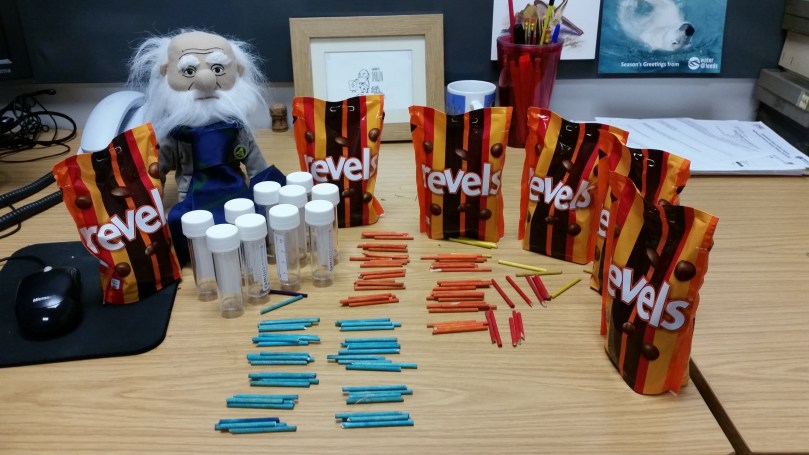
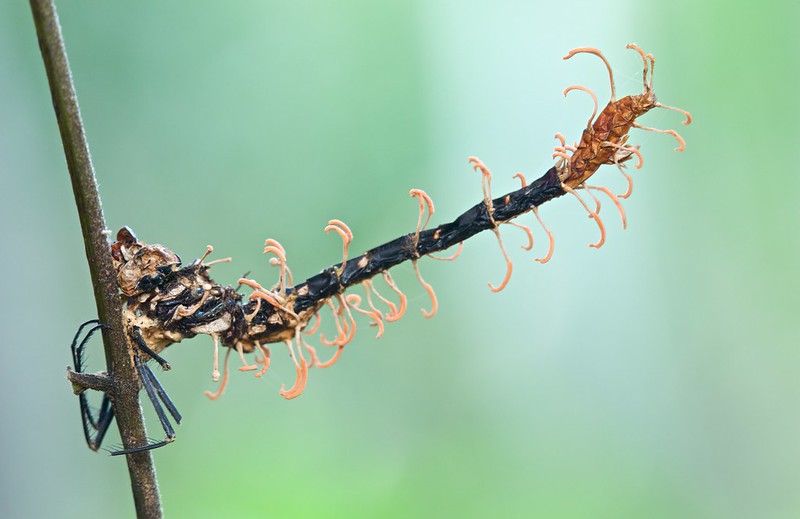

 Something strange seems to be happening in one particular species of damselfly, the common blue jewel
 For the two or three people who actually pay any attention to what I get up to here, you might have noticed a bit of a theme over the past couple of months: large numbers of posts (an anomaly in itself!) summarising some of my papers. I set myself the task of writing these lay summaries to try to make my work a little bit more accessible to people who might be interested in the topic but who might not have access to the paper, have the technical skills needed to interpret the findings, or who simply don’t have time to go and read a 7,000 word scientific article.
 Background: Body size is among the most important characteristics of animals and plants. Larger animals are capable of buffering against their environment (think big polar bear vs tiny chihuahua in the snow!) so that they can survive in a wider range of locations, are capable of eating a wider range of prey, and consume more prey than smaller animals leading to a stronger impact on ecosystems. However, we are still trying to understand the factors that influence body size, both ecologically and evolutionarily.
 Background: As well as publishing in ecology and evolutionary biology, I am also interested in how that publishing industry works. There is a clear need to disseminate information as widely as possible in order to accelerate the rate of testing of new theories and discovery of new information. However, some publishing models (and some publishing companies) hide scientific research away so that most people do not have access to that work. Self-archiving is a way for researchers to make available certain forms of their research without breaking copyright (which is almost always handed over to the publishers).
 Background: A large number of species are expanding their ranges in response to climate change. This is also true in the damselflies, where the small red-eyed damselfly (Erythromma viridulum) has recently (around 1998) crossed the sea from France to England. Since then, the species has moved hundreds of kilometres north in an unprecedented range expansion (at least as far as European dragonflies and damselflies are concerned). What is less clear is what impact this expansion has had on the species. Are the newly-founded populations the same as those that are resident in France? Can we trace the arrival and expansion of the species through genetic techniques?
 Katatrepsis