
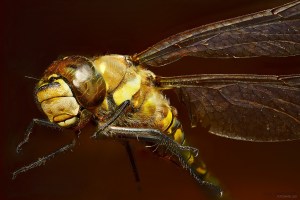
 Dragonflies are beautiful, alien-looking animals. They have bits that move and bend in ways that you wouldn’t expect, enormous eyes, and intricately patterned wings. I have written about the hydraulic gill system of dragonfly larvae, which powers both their jet propulsion and their “mask” that grabs prey. Meanwhile, dragonfly adults have basket-like legs to ensnare prey, as well as flexible abdomens which they use to form mating “hearts”. I’ve been interested in why dragonflies look the way they do, and that that means for their evolution, for a number of years.
I was intrigued, therefore, to read a paper that described how a pair of scientists had been able to tell dragonflies apart just by looking at the markings on their bodies. I do not remember how I first came across it, but the work is described in this German paper published in 2009 in the journal Entomo Helvetica by Schneider and Wildermuth*. The paper described a population of the southern hawker (Aeshna cyanea) in which a substantial number of animals could be identified from their facial markings. The paper is not creative commons so I can’t share the document, but you can see for yourself if you download the manuscript from the public link above and look at Figure 2 (it’s worth it – the pictures are stunning!). The title of the paper translates as “Dragonflies as individuals: the example of Aeshna cyanea“. So why might these markings occur?
There are lots of reasons why it might be advantageous for animals to be able to identify individuals. You might be trying to identify mates of high quality to increase your chances of reproduction. Many social animals (including humans, but also ants, meerkats, and molerats) distinguish relatives from non-relatives or friend from foe using sight or smell. Many theories of how cooperation evolved rely on animals having repeated interactions with one another, and remembering who has scratched whose back so that the favour can be repaid in the future. However, none of this applies to dragonflies. Dragonflies rarely have any structure to their mating (it’s usually first-come-first-served, and a mad scramble if many males are involved), they are not social (while they live in groups they do not necessarily act together), and they do not cooperate (apart from mobbing of predators such as hawks, but that’s probably not true cooperation).

More likely what we are seeing is not the evolution of a trait, but the by-product of another trait. In a provocative article written in 1979, Stephen Jay Gould and Richard Lewontin wrote about this idea**: that some things we observe in nature are not the product of evolution directly, but occur as a result of some adaptation. Gould and Lewontin gave the example of “spandrels” from Rennaisance architecture. Spandrels (like the example on the right, from the Basilica de San Marco in Venice) were the accidental byproduct of the way that arches were designed – a small curved area was left in the corner of the arch, and this was often filled with artistic renderings. However, the spandrel itself was never the focus of the design.
In the case of dragonfly faces, the same is likely true. Dark patches on insects are usually caused by a substance called “melanin” (which is the same pigment that produces darker skin in humans). Melanin is involved when insects fight off infections or heal injuries. It is most likely that the patterns on the faces of the dragonflies are due to some kind of damage, perhaps during emergence from the water, or perhaps as a result of conflict between territorial individuals. What is most interesting, though, is that Schneider and Wildermuth seem to have found a population in Switzerland that has an unusually high number of animals with such markings. When I went to Flickr to look through other photographs of this species, I found very very few examples. Below is a gallery of some of the creative commons photos, and there are many more if you go to Flickr yourself and search for “aeshna cyanea”.
That’s not to say there are no other examples. See here and here for examples of the markings in other photographs (but note that many of the most striking examples are taken by the same photographer).

The researchers who published the original paper offered an interesting addition to the literature on understanding individual insects. Usually, we do this by marking the animals (with dragonflies you can write on their wings, for instance, as you can see on the right) or more recently by attaching radio transmitters. There are some species that use natural markings to identify individual animals, including work on whales, dolphins, and killer whales. The technique is also used for some amphibians where the underside of the animals is often mottled in unique ways. However, given the fact that the markings are not always present, that we don’t know how long they last, and that the method requires some very specific (and challenging!) photography, it is unlikely that this particular method will be used widely in insect ecology. Instead, the study highlights an interesting example of unexplained variation in dragonflies, which deserves more study in its own right.
References
*Schneider, B. and Wildermuth, H. (2009) Libellen als Individuen – zum Beispiel Aeshna cyanea (Odonata: Aeshnidae), Entomo Helvetica, 2: 185-199.
*Gould, S.J. and Lewontin, R.C. (1979) The Spandrels of San Marco and the Panglossian Paradigm: A Critique of the Adaptationist Programme” Proc. Roy. Soc. London B, 205: 581–598
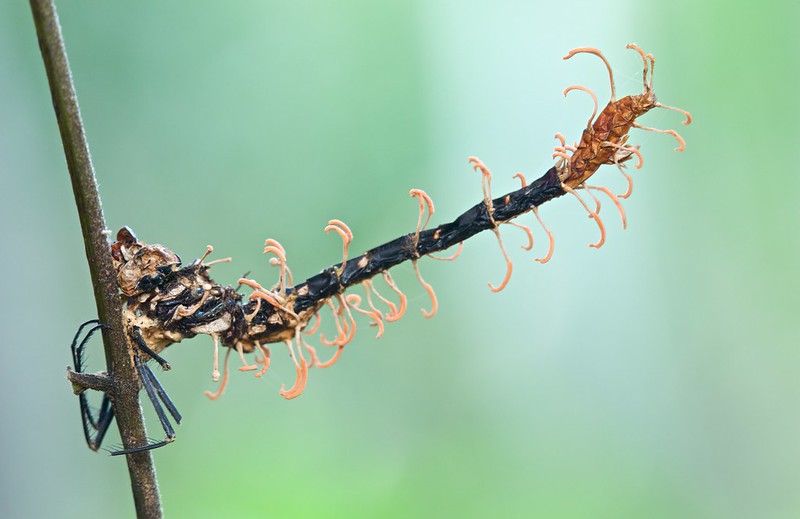

 Something strange seems to be happening in one particular species of damselfly, the common blue jewel
  Background: Body size is among the most important characteristics of animals and plants. Larger animals are capable of buffering against their environment (think big polar bear vs tiny chihuahua in the snow!) so that they can survive in a wider range of locations, are capable of eating a wider range of prey, and consume more prey than smaller animals leading to a stronger impact on ecosystems. However, we are still trying to understand the factors that influence body size, both ecologically and evolutionarily.
 Background: A large number of species are expanding their ranges in response to climate change. This is also true in the damselflies, where the small red-eyed damselfly (Erythromma viridulum) has recently (around 1998) crossed the sea from France to England. Since then, the species has moved hundreds of kilometres north in an unprecedented range expansion (at least as far as European dragonflies and damselflies are concerned). What is less clear is what impact this expansion has had on the species. Are the newly-founded populations the same as those that are resident in France? Can we trace the arrival and expansion of the species through genetic techniques?
 Background: Animals and plants have a wide range of colours, and these different colours play different roles in different species. Some species might be signalling to potential predators that they are toxic (like a wasp’s stripes), others might be trying to hide (like a moth’s speckled grey wings), and others might be trying to signal to the opposite sex that they are high quality mates (like a peacock’s train). However, while there are clear functions in principle, the relative importance of different signals might vary depending on the context within which the animal or plant finds itself. For example, male ebony jewelwing damselflies (Calopteryx maculata) have very dark wings and this is thought to allow females of the same species to choose appropriate mates (i.e. to avoid mating with the wrong species). However, the dark pigment can also play a role in temperature regulation. Damselflies cannot generate their own heat and so rely on absorbing heat from the sun, which is helped by the dark pigment. I was interested in how the darkness of the wings varied between locations which experience different temperatures.

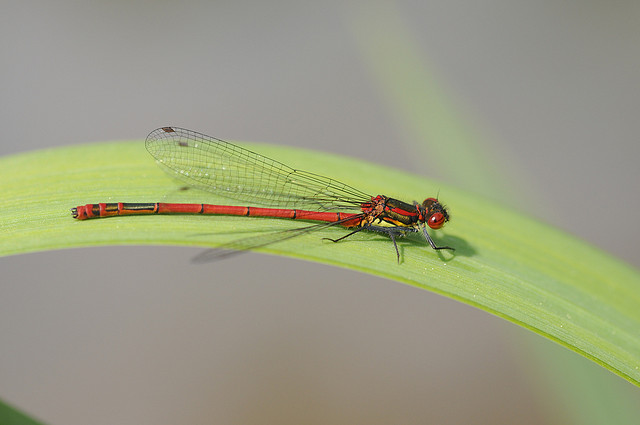
 Katatrepsis