PhD opportunities in ecology and evolution

As part of the new NERC Doctoral Training Program at the University of Leeds, I have two PhD projects to advertise that are now (as of 15th November 2013) open to applicants:

1: DragonFlight: Linking the mechanics and energetics of flight to conservation status and responses to climate change in dragonflies

dragonfly-177338_1280The DragonFlight project builds on my earlier interests in dragonfly dispersal (1), macroecology (2), and flight morphology (3).  There has quite a bit of work done on the flight of dragonflies, but much of this has taken place in the laboratory and has not considered what goes on in the field.  Similarly, there has been quite a lot of landscape-scale work done in the form of mark-recapture studies or analyses of historical records (including my own), but none of this has really tested for the traits that underlie flight ability.  This project will link detailed biomechanical measurements of dragonfly flight to our knowledge of responses to climate change (i.e. range shifts) or conservation status.

2: Teaching old beetles new tricks: applying novel genetic techniques to re-establish a classic ecological model system, Tribolium

I’m really excited about this project.  Andrew Peel, a colleague at Leeds, has been working on the evolution of beetles (and animals in general) for a while and uses Tribolium as a model system.  I have been interested in the ecology of this system for some time and this project represents us banging our brains together. In particular, there are lots of nice ways that we can incorporate Andrew’s contemporary genomic techniques (e.g. RNAi) to test for genetic drivers of ecological phenomena.  The species is also an important pest species of stored grain, making any advances potentially applicable to pest control.

Note that both of these are “competitively funded”, which means that there are more projects than we can fund.  We interview candidates for all projects and then award the best candidates the projects that they applied for.  There are more details on the website, including how to apply.  Deadline is 24th January 2014.


References:
(1) Hassall C, Thompson DJ (2012) Study design and mark recapture estimates of dispersal: a case study with the endangered damselfly Coenagrion mercuriale. Journal of Insect Conservation, 16, 111-120.
(2) Hassall C, Thompson DJ (2010) Accounting for recorder effort in the detection of range shifts from historical data. Methods in Ecology and Evolution, 1, 343-350.
(3) Hassall C, Thompson DJ, Harvey IF (2008) Latitudinal variation in morphology in two sympatric damselfly species with contrasting range dynamics (Odonata: Coenagrionidae). European Journal of Entomology, 105, 939-944.

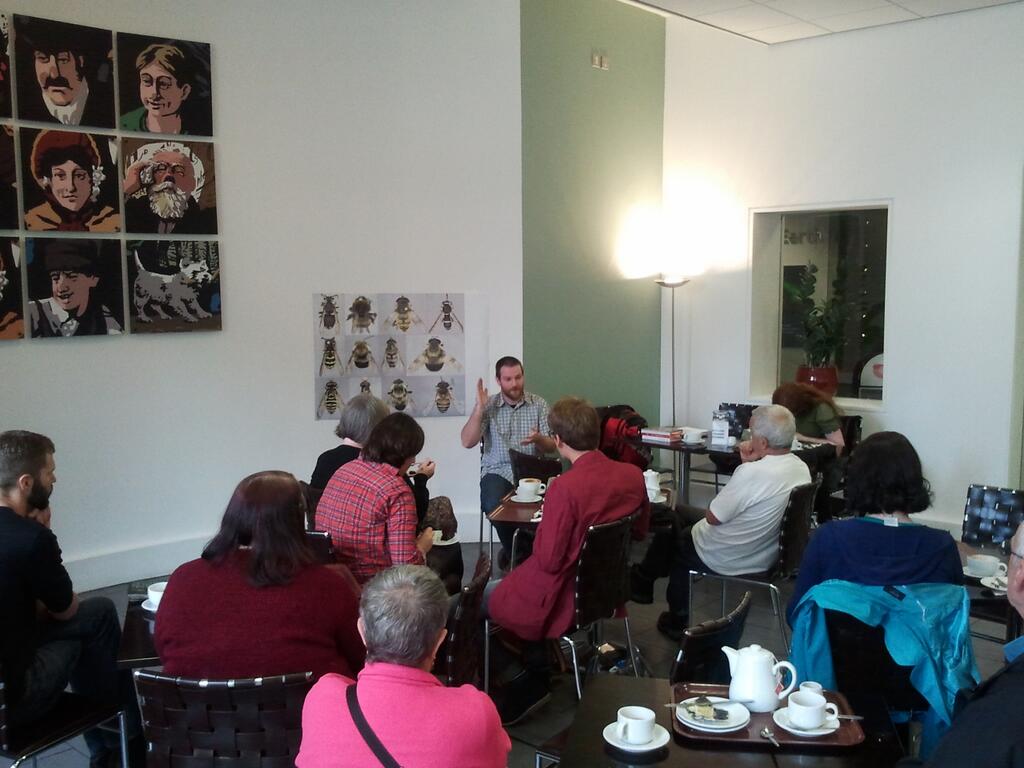
Communicating camouflage and mimicry: chocolate, hover flies and Teddy Roosevelt

BTo0JXhIUAA3dEE

In September I gave a Cafe Scientifique talk at the Leeds City Museum on the evolution of mimicry and camouflage.  For those of you who aren’t familiar with the concept, Cafe Scientifique offers an opportunity for scientists to give short (or long, depending on how it is run) talks on their research to a general audience and then take questions in an informal setting.  I have always been a fan of this kind of outreach, and when Clare Brown, the curator of Natural History at Leeds Museum asked if I wanted to give a talk I jumped at the opportunity.  I spent a bit of time pulling resources together for the talk and I thought I would post them here in case anybody else could find a use for them.  I have outlined the talk I gave below:Read More »

PubMed Commons is a huge leap forward

For me, PubMed Commons came out of nowhere.  I was aware of some innovations in publishing (check out journals like Cryosphere for examples of progress in academic publishing) but to have a huge group like PubMed involved in pro-actively pushing boundaries is a real game-changer. Here’s why it’s so important: academic publishing as it currently exists is broken. We have been using a model for publishing that is built around a century-old method for the dissemination of information.  This involves (i) the submission of articles to an editor, (ii) the selection of a small number (usually 2-3) of referees to review the paper and make sure it is adequate, and (iii) a judgement made by the editor and the referees as to whether or not the paper should be accepted.  At that point, the paper is either published (in which case it becomes a matter of record) or rejected (in which case it is never heard of unless published elsewhere).  What this means is that ENORMOUS amounts of scientific information is never seen, and that information that is released in given a sometimes-cursory review by a small number of people who may not be experts in the area.  The internet should already have changed that in a number of ways:Read More »

“Camouflage on the edge” – a new paper on concealing colouration

In 2012, the US Government cancelled a $5 billion camouflage project under which it had already supplied uniforms to soldiers in Afghanistan.  The pattern of camouflage, called the “universal camouflage pattern” (UCP) was supposed to allow soldiers to blend in equally well in forests, deserts, and urban environments but had been deployed but never properly tested to ensure that it provided proper protection.  When this testing was finally carried out, it demonstrated that the camouflage performed poorly, and was actually putting soldiers at unnecessary risk.  It got so bad that US Army soldiers were trading their uniforms with locals so that they could wear something with appropriate colouration.  What this goes to show is how poorly we understand the mechanisms underlying camouflage, even while we spend enormous amounts of money attempting to exploit the phenomenon.  A new paper that my colleagues (based at Carleton University) and I published today in the Royal Society journal Biology Letters adds a key piece to the camouflage puzzle by illustrating for the first time the mechanism behind “disruptive colouration“.  The paper can be viewed for free at the journal homepage, as can all Biology Letters articles, until 30th November 2013 – go browse, it’s a fascinating journal with short, varied, interesting papers.

Read More »

A new MOOC from Leeds: “Fairness and Nature: When Worlds Collide”

Picture1It’s a pretty exciting time to be teaching in higher education.  There has been a wave of critical evaluation (mostly by the teachers themselves) which has led to a great deal of progress over the past couple of years.  This has led to a recognition that lecture-based courses are not the “be all and end all” of university teaching, and that there are better ways to do things.  Massively Open Online Courses (MOOCs for short) are playing quite a large role in redefining how university teachers engage with their students and how we think about delivering the student experience.

The new MOOC from the University of Leeds is called “Fairness and Nature: When Worlds Collide”, and is being run by Professor Jon Lovett in the School of Geography. Jon is a charismatic and passionate guy with a wide range of experiences in the interaction between people and the nature world, and it is these themes that are explored in the course.  If you want to find out more, head over to the FutureLearn site and sign up (it’s free!).  Here’s a taster:

There are some key characteristics of MOOCs that make them different from conventional university courses:

  • Variable length – MOOCs can be anything from 1 week to 12 weeks, with the breadth and depth of content varying accordingly.
  • Entirely online – with no need to rely on built infrastructure, MOOCs can (and, indeed, do!) cater for tens of thousands of students, rather than the usual hundred or so.
  • Flexible study – because of the online nature, students can participate whenever is convenient for them.  Sometimes this means that students drop-off entirely (completion rates are relatively low) but that isn’t really the point of MOOCs.  MOOCs are frequently designed to provide access to education for as many people as want it, and any learning is a bonus.
  • Flexible structure – the online platform allows a wide variety of multimedia, interactive, connected resources to form the backbone of a course.  These make for a very engaging learning experience.

All these factors combine to make a new and interested way of teaching and engaging a wider range of students, and I look forward to seeing where the MOOC movement goes.

The perils of predictability

Order is a standard part of nature, from the mathematical patterns found in natural structures to the predictable variation in sunrise times at different times of year. Indeed, animals and plants rely on regular, logical ordering of events.  For example, in my work on pollinator ecology bees rely on seasonal patterns in flower blooming as a food source. But this regularity is a double-edged sword: just as a bee can exploit regularity in flowering times, so can birds exploit the regularity in bee occurrence. A shared synchrony of life cycles brings costs and benefits. And this is where we bring in the Greek sea-god Proteus (pictured right). Proteus was a god who was able to change his form to avoid having to tell the future, and he has given his name to “protean” phenomena – those phenomena that are changeable or unpredictable. We can see a potential benefit in the plants altering their timing of flowering (of exhibiting protean flowering patterns) – if they remain predictable then the bees on which they rely for pollination are also predictable, which means that they are easy to exploit as food for birds. However, unpredictable flowering times might result in flowers occurring when there are no pollinators, which would be bad for both groups. Synchrony in the seasonality of flowers, insects, and birds is a complex association between populations (or even communities) of animals, and this makes evolutionary change slow.Read More »

Using R to look at engagement with Twitter at scientific conferences

Beh13 presentationI have been busy attending conferences recently (one of many excuses for not updating the blog) and I thought I would mention one significant difference between these conferences and those that I have attended previously.  At Behaviour 2013 (Newcastle, 4-8 Aug 2013 – that’s me talking about mimicry on the right), I tried live-tweeting for the first time.  Then at Intecol 2013 (London, 18-23 Aug 2013) almost all questions during the plenary talks were taken solely by Twitter.  This meant that I had a lot more experience of Twitter in an academic forum that I had had before, and I found it to be an immensely positive experience!  Not only did people come up and say “hi” because they recognised my name from Twitter (new networking opportunities), but I passively participated in multiple parallel sessions where usually I would only have had access to the session within which I was physically present (there were 16 parallel sessions at any one time at Intecol!).Read More »

Six tips for biologists starting out on Twitter

Last week, I had an interesting conversation over coffee with some colleagues who don’t use Twitter.  There were a lot of concerns over whether Twitter was useful at all, and whether it was right for them in particular.  I imagine a lot of people (including scientists) are hesitant about taking the plunge and don’t have time to fiddle around trying to figure out how to use the tool.  First, for those who have not come across Twitter before, there is some terminology to cover:Read More »

Do Power Balance wrist bands work? Of course they don’t…

Silicone wrist bands and other “performance jewellery” have become commonplace among sports stars (see Paul Collingwood and Andrew Strauss, England cricketers, who are bedecked in several varieties).  Power Balance, Harmony, Ionic, Q-Ray, Balance, Bio-Ray, IRenew and Rayma are some of the many brands that you might see online or in sports stores.  I have been writing about negative ions and balance bands for a few years now, but most of that focused on the inherent lack of a plausible mechanism by which the things could work.  Since I wrote those posts, there have been a number of clinical trials published, and I thought it would be worth trying to pull some of those together to provide an overview of the science.  I have linked to all the studies so you can check them out yourself.

Summary: I found seven studies: four journal articles, one MSc thesis, one research poster, and one conference presentation which was an expansion of a journal article.  The studies included a total of 193 participants and looked mainly at balance, strength and agility, all using the Power Balance band (in which holograms are the supposedly active part).  None showed any improvement in performance with the band, but study quality varied.  Interestingly, some studies suggest that the placebo effect might not even be present. However, another study showed that the placebo effect with this product is strongly dependent upon prior beliefs, and that performance may even suffer while wearing a band if the participant does not believe that the band will help. I was not able to find any tests of bands in which “ions” were purported to be the mode of action.

Read More »