Citizen science needs fancy statistics to detect the impacts of climate change

Background:  Climate change is causing a range of effects in plants and animals. One of the most noticeable is the colonisation of new areas as the environment warms to a point where animals are able to persist where once they could not. However, the sources of data used to detect these kinds of patterns tend not to be systematically collected and so present unique challenges during analysis. In particular, a lot of existing data on sightings of animals that are used to detect trends under climate change originate from enthusiastic amateurs who make a note of which species they see and where.

What we did: I analysed a series of different methods that have been used to control for the effects of recorder effort bias in the detection of range shifts.  This recorder effort bias occurs when there are far more recorders looking for animals in a later period and so the chance of discovering those extreme populations increases. Thus range shifts could simply be an artefact of increased sampling. I demonstrate that the methods that have been used before vary in the detection of range shifts and that some make more sense than others. I follow this up with a case study on range shifts in British Odonata and make recommendations concerning the most appropriate methods.

Importance: Climate change is an important issue and we need cutting-edge analytical tools if we are to properly assess its impacts on the world. I hope that this paper has contributed to this aim.


This is part of a series of short lay summaries that describe the technical publications I have authored.  This paper, entitled “Accounting for recorder effort in the detection of range shifts from historical data”, was published in the journal Methods in Ecology and Evolution in 2010. You can find this paper for free online at the publisher.

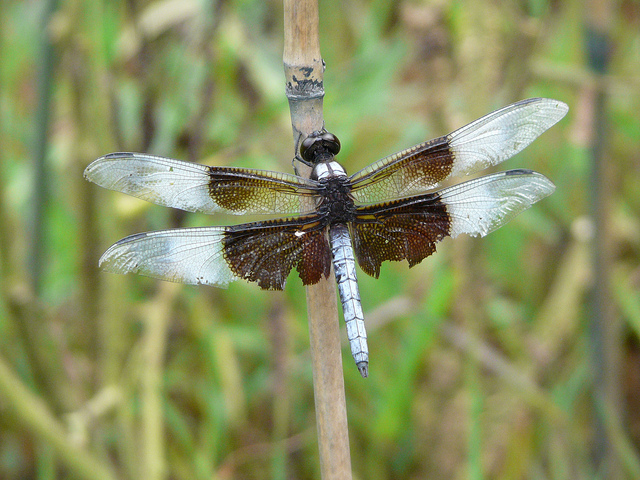
Image credit: Ken Slade, CC BY-NC 2.0, http://bit.ly/1qAae4a

Computer models can predict where rare species might be found

Background:  Species distribution models (SDMs) have been used for a number of different purposes. This approach involves the mapping of species distributions (like the map shown on the right, for the citrine forktail damselfly) onto environmental variables to evaluate the contributions of those variables to determining the species range. This knowledge can then be use to predicted where the species will be in the future under climate change. However, another way in which they can be used is to predict in which areas the species has not been found but could potentially exist.

What we did: My study applied SDMs to this latter problem, predicting where 176 species of North American dragonflies and damselflies occur based on the patchy recording that is currently available.  The models fitted reasonably well, which isn’t surprising given the reliance of dragonflies and damselflies on warm, dry weather for their adult stage.  This highlighted areas for which the models predicted species presence but where those species had not been recorded.  I also demonstrated that the patterns of diversity found in North America were consistent with those found in Europe.

Importance: This kind of study can be used to predict where rare or endangered species may have gone undiscovered as well as directing limited conservation efforts towards areas that are likely to have high diversities of animals or plants but have not been properly explored. We can also look for regions that have been under-surveyed and where resources need to be focused.


This is part of a series of short lay summaries that describe the technical publications I have authored.  This paper, entitled “Predicting the distributions of under-recorded Odonata using species distribution models”, was published in the journal Insect Conservation and Diversity in 2012. You can find this paper online at the publisher, or on Figshare.

Image credit: L. B. Tettenborn, CC BY-SA 3.0, http://bit.ly/XHiqce

Lots of damselflies age, especially when males compete for territories

Background: When this paper was published, we had already demonstrated that ageing (an increase in the probability of dying in older individuals) was present in one species of damselfly. This was a surprise, as many biologists speculated that short-lived animals like damselflies did not live long enough in the wild to experience ageing. However, anybody who has worked with insects in the field knows that they exhibit clear signs of ageing like the tattered wings of the dragonfly shown above. Having shown that at least one species of damselfly age, it was still unclear as to whether this was the exception or the rule.

What we did: We expanded our analysis from a single species to consider all the species for which there was published data on age-related mortality which we could use to detect ageing.  We found that this phenomenon was present in the vast majority of studies in which we were able to test for it.  Furthermore, we were able to show that it was more apparent in territorial species where males face greater stress in having to defend their territories to obtain mates.

Importance: This study conclusively demonstrated that ageing is commonplace in dragonflies and damselflies, where once it had been proposed that no wild insect populations exhibited ageing at all. We also show a hallmark of the evolution of territoriality in the lifespans of dragonflies and damselflies.


This is part of a series of short lay summaries that describe the technical publications I have authored.  This paper, entitled “A comparative analysis of senescence in adult damselflies and dragonflies”, was published in the Journal of Evolutionary Biology in 2011. You can find this paper online at the publisher, or on Figshare.

Image credit: steews4, CC BY-ND 2.0, http://bit.ly/1rrAEeW

Damselfly sex doesn’t always produce children, and that’s a problem for evolutionary biologists!

Background:  At the core of ecology and evolutionary biology is the concept of “fitness”, broadly defined as the number of copies of an animal’s genes it manages to leave in subsequent generations. However, biologist rarely measure this genetic fitness.  Instead, we use proxies such as the number of times an animal mated or the number of eggs an animal laid. Sometimes, we use proxies that are even further removed, such as body size (under the assumption that larger females lay more eggs).

What we did: This study compared two traditional forms of fitness measurement, daily mating rate and lifetime mating success, with a genetic measure of fitness based on finding the number of offspring each individual produced in the next generation.  We monitored a single, isolated pond over two years and individually identified all damselflies of the species Coenagrion puella, the azure damselfly.  Each individual also had a genetic sample taken and we used genetic markers called “microsatellites” to identify each individual.  When we came back the next year, we did the same thing.  This species goes through one generation per year so we knew that all the animals in the second year were the offspring of those in the first.  By comparing the genetics of the potential parents with those of the potential offspring we were able to assign offspring to parents to produce a much more accurate picture of this concept of “fitness”.  Unfortunately, what we found was that our behavioural measurements did not reflect this more accurate measure of fitness.

Importance: Since the concept of fitness is so important to evolutionary biology, it is important to test the assumptions of the studies that have sought to measure it.  We have demonstrated that some of those previous studies were not using particularly reliable proxies for fitness.  However, we have provided a case study of a potential method for avoiding these problems: by directly genotyping and assigning parents to offspring in the field we can get a much clearer picture of what “fitness” really means.


This is part of a series of short lay summaries that describe the technical publications I have authored.  This paper, entitled “Field estimates of reproductive success in a model insect: behavioural surrogates are poor predictors of fitness”, was published in the journal Ecology Letters in 2011. You can find this paper online at the publisher, or on Figshare.

Image credit: One of mine, CC-BY 3.0

It’s hard to predict how many species a pond might contain…

Background:  Ponds have been identified as a very important habitat in the landscape.  They enhance regional biodiversity, help control floodwater, reduce pollution in run-off from agricultural and urban land, and provide greenspace and biodiversity in urban environments.  However, because of their small size (typically less than two hectares), they have been neglected by scientists until the last couple of decades.

What we did: This study used a large dataset of 454 ponds that had been surveyed in the north of England to identify all of the invertebrate and plant species that inhabited them. A wide range of physical, chemical and biological variables were also measured and, as the title of the paper suggests, we investigated which of these variables were related to the species richness of different plant and animal taxa. We were able to predict a reasonable amount of the diversity of invertebrates in general, but predictions varied between groups of invertebrates. In general, more shade and a history of drying up reduced the diversity of all groups.

Importance: It has been shown that landowners and managers tend to manage ponds and other natural resources using “received knowledge”. in other words, there is little evidence base for such management.  Our study demonstrated a few important relationships which can be used to inform this kind of management.


This is part of a series of short lay summaries that describe the technical publications I have authored.  This paper, entitled “Environmental correlates of plant and invertebrate species richness in ponds”, was published in the journal Biodiversity and Conservation in 2011. You can find this paper online at the publisher, or on Figshare.

Image credit: That’s one of mine, CC-BY 3.0.

Ponds are dynamic habitats, which makes it tough to conserve biodiversity…

Background:  When an area is designated as a site for conservation or special scientific interest that is usually because one or more species of interest have been found or the community as a whole is unique or exceptional. However, the implicit assumption in this approach is that if you come back tomorrow then those species or that community will still be present. If the habitat is dynamic, with frequent population-level extinctions and colonisations, then it may be that this assumption does not hold. Pond ecosystems represent one case where the habitats are small and relatively easily affected by external variables and which may, as a result, vary in their conservation value over time.

What we did: Andrew Hull and Jim Hollinshead have been monitoring ponds in Cheshire (northwest England) for almost 20 years. A set of 51 ponds were surveyed in 1995/6 and again in 2005, meaning that we can test whether or not over this 10-year period there was any change in the conservation value of the ponds. Pond surveys recorded all plant and macroinvertebrate (i.e. invertebrates larger than about 1mm, which was the size of the mesh of the net) species in the ponds and we compared (i) the diversity, and (ii) the conservation value of the ponds between the two surveys. Plants showed similar levels of diversity in both surveys, so highly-diverse ponds in the first survey remained that way in the second. However, invertebrate diversity was not correlated between surveys, meaning that species rich ponds in the first survey did not necessarily remain that way. For both groups there was not correlation between conservation value (calculated based on the rarity of the species in the community) in survey 1 compared to survey 2.

Importance: Ponds are highly variable ecosystems and that is one of the reasons that they support such a wide range of species on a landscape scale. However, it seems that this variability may make it difficult to conserve them adequately, since conservation value is changing over time. This finding supports the conservation of pond clusters, rather than individual sites, which are more likely to contain a stable species pool.


This is part of a series of short lay summaries that describe the technical publications I have authored. This paper, entitled “Temporal dynamics of aquatic communities and implications for pond conservation”, was published in the journal Biodiversity and Conservation in 2012. You can find this paper online at the publisher, or on Figshare.

Image credit: Alison Benbow, CC BY 2.0, http://bit.ly/1l35Tdu

Less common species tend to have more parasites

Background:  Parasites and the individuals that they attack (called “hosts”) often have a long evolutionary history of interaction. This history often plays-out as an “arms race” where the parasite finds a new way of attacking the host and the host then evolves a defence against that attack, followed by subsequent evolution by the parasite. Not only this, but species of parasites (such as the aquatic mites and protozoa that I work on) that exploit many host species can differentially affect those different hosts. In this study, we were interested in how parasitic protozoa affect closely related damselfly species that differed in their distributions.

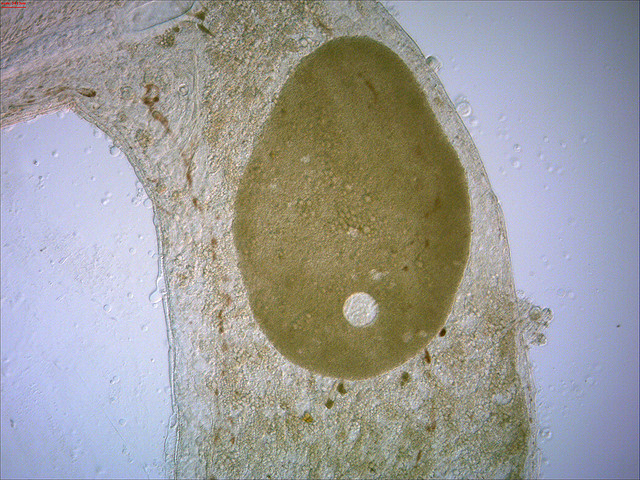
What we did: Julia Mlynarek, a PhD student at Carleton University, collected a large number of damselflies from a number of sites around eastern Ontario. The species were grouped into pairs so that we could compare between species from the same genus.  She dissected these to find the number of protozoa (like the one shown above) in guts of each animal. We found that species with smaller geographical distributions tended to have more protozoan parasites than closely related species with larger distributions.

Importance: Explaining how parasites affect their hosts is a big question spanning ecology and evolutionary biology. These results suggest that there might be a combined effect of (i) shared parasites due to evolutionary history, and (ii) varying resistance due to different exposure across geographical ranges.


This is part of a series of short lay summaries that describe the technical publications I have authored.  This paper, entitled “Higher gregarine parasitism often in sibling species of host damselflies with smaller geographical distributions”, was published in the journal Ecological Entomology in 2012. You can find this paper online at the publisher, or on Figshare.

Image credit: Christophe Laumer, CC BY 2.0, http://bit.ly/1rrvyzt

Yet another post about gender and academic conferences

genderThis is becoming something of a cottage industry recently – it is fairly straightforward to calculate the gender ratio of presenters at academic conferences and to evaluate that ratio against some theoretical baseline. However, these sorts of questions are important to look at because the work is highly complex and so requires a large number of people looking at the diverse kinds of conferences to provide a bigger picture. A number of previous studies have shown a range of different patterns in gender and academic conferences (references at the bottom):Read More »

Study design and mark recapture estimates of dispersal [paper summary]

This is part of a series of short lay summaries that describe the technical publications I have authored.  This paper, entitled “Study design and mark recapture estimates of dispersal: A case study with the endangered damselfly Coenagrion mercuriale”, was published in the Journal of Insect Conservation in 2012. You can find this paper online at the publisher, or on Figshare.

9303167014_cdbcb32d61_zBackground:  I have long been interested by movement of animals in the landscape and whether or not this can be accurately quantified in the field.  One of the major issues associated with these field studies (such as mark-release-recapture studies, in which animals are marked with a unique tag then recaptured at a later time) is that you cannot detect dispersal distances that are greater than the size of the study area that you are using.  For example, people have been marking damselflies for decades to try to measure how far they fly.  However, if you only look for them 500m from where you first found them, you won’t find them flying any further than that.

What we did: This study used a large mark-release-recapture dataset and investigated the effect that expanding a study area has on the maximum dispersal distance detected.  We found that the original study (on the endangered southern damselfly, Coenagrion mercuriale) was at a scale sufficient to estimate the maximum distance that the insect is able to fly, around 2km.

Importance: This endangered species has very specific habitat requirements (water meadows and shallow ditch systems) which mean that it has a long distance to move between these rare areas.


Image credit: Paul Ritchie, CC BY-NC-ND 2.0, http://bit.ly/1sZpjCC

Good mimics have the costumes and the acting skills

There are lots of ways to fool an observer, and I mentioned quite a few in my post on the Cafe Scientifique talk that I gave in September. However, one aspect that I didn’t mention there was “behavioural mimicry” – where an animal acts like another animal in order to fool a potential predator or prey.  This sort of behaviour has been reported plenty of times in the field, but has never been studied in a systematic way. My collaborators over at Carleton (led by Tom Sherratt and Heather Penney, who collected the data as part of her MSc thesis work) and I have just published a paper (press release here) which provides just such an overview, and tests a few key evolutionary hypotheses along the way.Read More »