
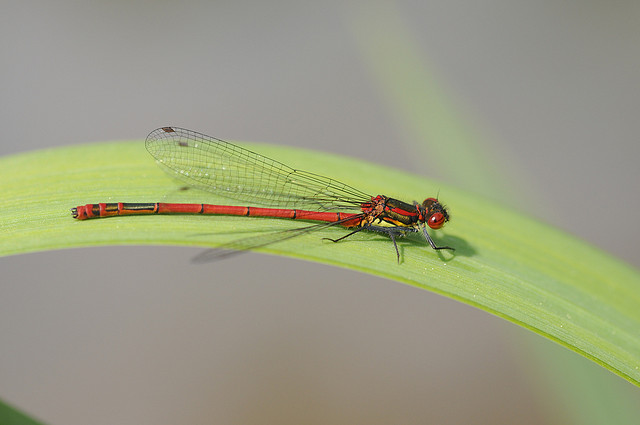
 Background: A large number of species are expanding their ranges in response to climate change. This is also true in the damselflies, where the small red-eyed damselfly (Erythromma viridulum) has recently (around 1998) crossed the sea from France to England. Since then, the species has moved hundreds of kilometres north in an unprecedented range expansion (at least as far as European dragonflies and damselflies are concerned). What is less clear is what impact this expansion has had on the species. Are the newly-founded populations the same as those that are resident in France? Can we trace the arrival and expansion of the species through genetic techniques?
What we did: Simon Keat was a PhD student at the University of Liverpool who was lucky enough to be just beginning his PhD when the small red-eyed damselfly first established in the UK. Simon surveyed a number of populations around Europe and in the UK, collecting animals to measure them and extract DNA. With the body size measurements we showed that animals tend to show a strong relationship with latitude: populations further north were much larger and this held for both the older populations in France, Belgium and Germany as well as the newer populations in the UK. Looking at the genetics, we had expected to see declining genetic diversity further north, as a small number of individuals led the charge up the country. However, instead of a decline in diversity in the UK we saw an almost complete lack of genetic pattern. This suggests that the animals were moving in such great numbers that there was not the time for any local patterns to develop.
Importance: Range expansions have important consequences for many aspects of human life: agricultural pests shift and threaten crops, diseases and their vectors shift and threaten human health, and endangered species shift and potentially move out of protected areas. We have shown that during this particular range expansion there has been negligible change in genetic structure but that newly-invaded areas contain relatively large damselflies. Since damselflies are voracious predators, this could have substantial implications of local ecosystems.
This is part of a series of short lay summaries that describe the technical publications I have authored. This paper, entitled “Bergmann’s rule is maintained during a rapid range expansion in a damselfly”, was published in the journal Global Change Biology in 2014. You can find this paper at the publisher or archived at figshare.
Image credit: Quartl, http://bit.ly/1uX3BOA, CC BY-SA 3.0.
 Background: One of the fundamental questions in ecology is “what drives changes in the numbers of species in time and space?” We can look around us today and see that there are generally many more species in the tropics than nearer the poles. However, another way in which we can look around ourselves is to delve into the fossil record to look back in time. Dani Fraser is a PhD student at Carleton University working on large-scale patterns in fossil mammal biodiversity. Dani was interested in looking at spatial patterns and how they changed through time, but rather than just calculating the number of animals living in each area at each time, we looked at the rate at which the communities changed as we moved further north. The idea is that when climates are relatively stable and warm there is little variability in climate and so there is gradual change in species as you move north. However, as the climate becomes more polarised (i.e. colder at the pole relative to the tropics) the rate of change in animal communities becomes more pronounced.



 Katatrepsis