Damselfly wings change shape in harsher habitats

Background: Odonata (dragonflies and damselflies) are an ancient order of insects. By this, I mean that they have remained largely unchanged since their ancestors evolved 500 million years ago.  They have a fairly unique flight style which is a product of the configuration and use of their wings. Wing length has been used as a measure of odonate body size for many years, but wing shape has received less attention.

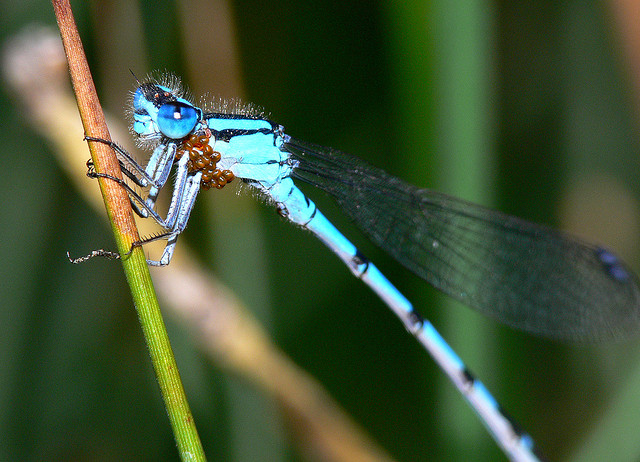
What we did: I was interested in whether wing shape varied with latitude in the UK.  The populations living in habitat in the UK are exposed to a range of temperatures depending on location and it might be that certain wing shapes confer advantages in certain habitats. Based on a survey of seven populations of Coenagrion puella, I compared wing shape using a method called “geometric morphometrics”.  This allowed me to look at shape independently of the size of the wing.  I found that the wing shape in the majority of populations was very similar.  All populations in the south of England were comparable, but the populations in the south of Scotland showed a progressive shift away from this “typical” wing shape until a site near Edinburgh which was significantly (if subtly) different.

Importance: Wing shape has been highly conserved throughout odonate evolution (i.e. ancient odonates are similar in shape to present-day odonates). Because even small variations between species are consistent, wing shape and patterns of wing veins have been used to identify species. My study showed that these wing shapes were not as consistent as people had previously thought and that there might be ecological or evolutionary processes that can cause significant variation.


This is part of a series of short lay summaries that describe the technical publications I have authored.  This paper, entitled “Wings of Coenagrion puella vary in shape at the northern range margin (Odonata: Coenagrionidae)”, was published in the International Journal of Odonatology in 2008. You can find this paper online at the publisher, or on Figshare.

Image credit: Lauri, CC BY-NC-SA 2.0, http://bit.ly/1zicIZC

The impact of environmental warming on Odonata – a review [paper summary]

This is part of a series of short lay summaries that describe the technical publications I have authored.  This paper, entitled “The impact of environmental warming on Odonata – a review”, was published in the International Journal of Odonatology in 2012. You can find this paper online at the publisher, or on Figshare.

Background: Odonata (dragonflies and damselflies) are thought to have evolved in the tropics and possess a number of adaptations that allow them to exist at higher latitudes.  This makes them interesting to investigate in the context of climate change, since these adaptations might facilitate a response to increasing temperatures.

What we did: This paper is a review of the literature looking at the ecology and evolution of Odonata in the context of climate change.  A number of areas are discussed including distributional changes, phenological shifts, evolutionary responses, the effects of drought and the physiological effects of temperature.

Importance: A large amount of work has been carried out on the influence of temperature on the biology of Odonata over the past 50-60 years.  This has come from a variety of loosely-related fields and our review brings this together to provide an overview of the state-of-play concerning our understanding of the topic.


Image credit: Patricia H Schuette, CC BY-NC-ND 2.0, http://bit.ly/1BO5i4r

Damselflies change shape under climate change, only if they are close to their limits

Background: A species’ shape and size can tell you a lot about how the animals are doing in their environment.  For example, species tend to get larger at cooler temperatures, a phenomenon known as “Bergmann’s rule”, and they tend to have greater dispersal traits where they need to move further (such as locations where habitat patches are further apart).

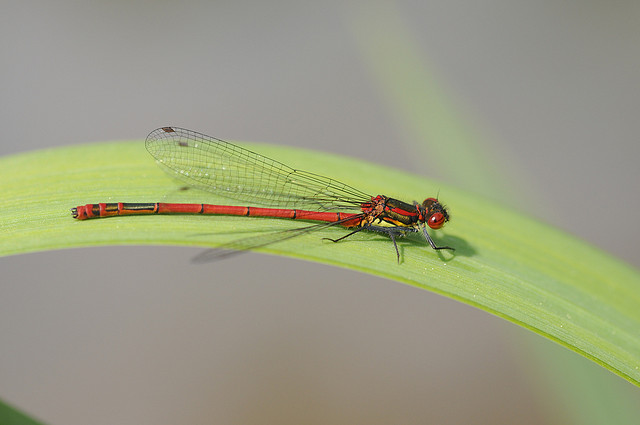
What we did: I was interested in shape and size varied between a species that is not moving north under climate change (Pyrrhosoma nymphula, shown above) and a species that has been expanding its range into Scotland (Coenagrion puella). I collected animals at a series of sites from southern England to Scotland for both species.  The results showed that there was little consistent variation in size or dispersal traits in P. nymphula but that C. puella showed increases in size and the relative investment in the thorax and abdomen (indicative of greater flight ability).  These results, taken together, suggest that there has been selection for dispersal traits in the expanding C. puella.

Importance: The presence of traits that could facilitate response to climate change, such as enhanced dispersal to increase colonisation of new habitats, could make the difference between a species thriving or failing under climate change.  This is particularly important for species that rely on aquatic habitats for their life cycle, because water resources are predicted to be under increasing threat in the future.


This is part of a series of short lay summaries that describe the technical publications I have authored.  This paper, entitled “Latitudinal variation in morphology in two damselfly species with contrasting range dynamics”, was published in the European Journal of Entomology in 2008. You can find this paper for free online at the publisher.

Image credit: Thomas Bresson, CC BY 2.0, http://bit.ly/1p25AAC

Damselflies develop “spotty wings” when it gets cold

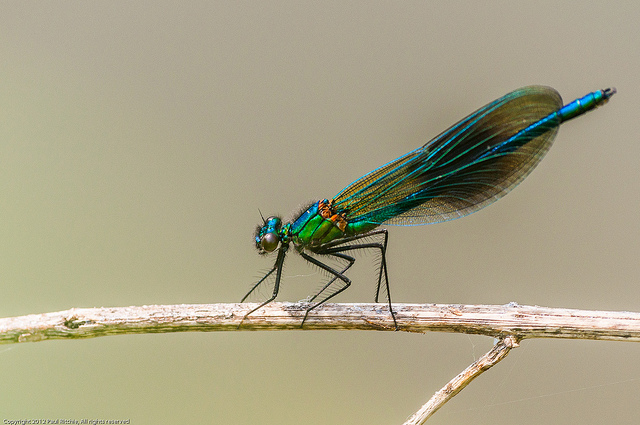
Background:  Darwin argued that sexual selection (i.e. the competition between males for females, and the females choosing from among competing males) was as important as natural selection (e.g. predators catching the slowest prey) in driving the evolution of traits. Calopteryx splendens, the banded demoiselle, is a fascinating case of this sexual selection. Males have pigmented bands on their wings which they use to signal to females. Females have been shown to prefer males with bigger bands. Further research demonstrated that the substance that produces these spots is the same substance, melanin, that drives the invertebrate immune response. The male damselflies are, therefore, advertising the strength of their immune system to females in an “honest” display.

Screen Shot 2015-11-01 at 17.25.05What we did: I was interested in the extent to which the wingspot size varied with latitude, since melanin production is strongly tied to temperature.  I had samples of C. splendens from two sites, one in Bedfordshire and another in Northumbria (near to the furthest north site where the banded demoiselle is found).  These two populations showed marked differences in the size of the area of pigment with far more pigment in the south, as would be expected if temperature was a limiting factor. You can see this variation in the picture on the right, which shows a Bedfordshire demoiselle on top and a Northumberland demoiselle on the bottom. The species actually changes from having a discrete band to many animals having only a “spot” in the northern population.

Importance: This was the first demonstration of geographical variation in wingspot size and suggested that ecological (i.e. temperature) processes were influencing wingspot size in addition to evolutionary (i.e. female choice) processes.


This is part of a series of short lay summaries that describe the technical publications I have authored.  This paper, entitled “Variation in the wingspot size and asymmetry of Banded Demoiselle Calopteryx splendens (Harris, 1792)”, was published in the Journal of the British Dragonfly Society in 2009. You can find this paper on Figshare.

Image credit: Paul Ritchie, CC BY-NC-ND 2.0, http://bit.ly/VIQrHD

Damselflies change shape as they move north

Background: It has been proposed that animals and plants of the same species vary in their shape and size depending on where they live. Individuals living close to the cooler, northern range boundary might possess traits that increase their ability to deal with cooler temperatures, for example. However, under climate change the places where animals can live are expected to move as warmer temperatures expand the areas where climate is suitable for different species.

What we did: This study was part of my doctoral research and compared populations of three species between their range core and their range margins.  The three species varied in the degree to which they were expanding their ranges under climate change: Pyrrhosoma nymphula (the large red damselfly) is not expanding in the UK and is found all the way to the northern coast of Scotland, Erythromma najas (the red-eyed damselfly) is found as far north as Cheshire and is not expanding its range margin, and Calopteryx splendens (the banded demoiselle) is found as far north as Northumbria and is expanding rapidly.  The results showed that there was greater variation between the core and range margins in C. splendens, the species which was expanding, less difference in E. najas which is barely expanding, and almost no difference in P. nymphula, which has expanded its range as far as it can.

Importance: In order to respond to climate change, species will likely need to shift their geographical ranges.  This involves being able to colonise new habitats which are currently outside of their range. The detection of variation in morphology such as in this study suggests that there might be traits that would facilitate this colonisation at range margins. If it could be demonstrated that the variation in morphology was evolutionary and not the result of phenotypic plasticity, then this would provide important evidence of adaptation to coping with climate change.


This is part of a series of short lay summaries that describe the technical publications I have authored.  This paper, entitled “Variation in morphology between core and marginal populations of three British damselflies”, was published in the journal Aquatic Insects in 2009. You can find this paper online at the publisher, or on Figshare.

Image credit: Jean-Daniel Echenard, CC BY-ND 2.0, http://bit.ly/1AHimY5

Climate change interferes with our use of animals to judge water quality

Background: Water quality is measured in a number of different ways: measuring levels of chemicals and pollutants, measuring temperature and other physical parameters, and monitoring the animals and plants that are living in the water. The theory is that the animals and plants living in the water have certain requirements of their habitat (particularly a need for clean water) and so you can use the presence of certain “fussy” animal groups as a proxy for water quality. The problem is that, under climate change, species are moving around as environmental conditions – especially temperature – changes.  This means that changes in the animal and plant communities at a given site might give the appearance of an increase in water quality while actually the arrival of new species is simply the result of climate change.

What we did: I analysed an extensive dataset of British dragonfly and damselfly (known collectively as the “Odonata”) sightings to look for a pattern of geographical movement since 1960.  Dragonflies and damselflies are an important group in biological water quality monitoring, as they are particularly sensitive to pollution.  I found that the patterns of water quality that would be detected using Odonata at a generic site would appear to change over time with the changes in Odonata communities, independent of any changes in water quality.

Importance: Biological communities are used extensively in the monitoring of freshwaters and this research emphasises the need to take distributional shifts that occur as a result of climate change into account when using this method. It is likely that water quality is improving, with better treatment of wastewater and better enforcement of environmental regulation, but accurate monitoring is the key to continuing improvement. Secondly, this paper demonstrates once more the fact that Odonata are responding to climate change.


This is part of a series of short lay summaries that describe the technical publications I have authored.  This paper, entitled “The impact of climate-induced distributional changes on the validity of biological water quality metrics”, was published in the journal Environmental Monitoring and Assessment in 2010. You can find this paper online at the publisher, or on Figshare.

Image credit: Tambako the Jaguar, CC BY-ND 2.0, http://bit.ly/1v8EGcK

Massively Online Open Courses (MOOCs) in Higher Education

I have written before about the fact that massive open online courses (MOOCs) can play a complementary role to that of traditional teaching within higher education. There are a number of platforms offering these courses now, and academics should certainly consider including components of MOOCs in their teaching. Here are a few of the platforms:


My own institution, the University of Leeds, has partnered with one of the newer MOOC providers: a UK-based group of universities called FutureLearn. These courses represent the most recent evolution of MOOCs, away from simply posting standard lectures and quizzes online and towards the production of MOOC-oriented materials that make the most of the distributed learning environment. This includes a lot of great multimedia content, auto-graded quizzes, animations, discussion boards, and a whole lot more.


PictureAs of April 2013, Udacity offers 24 courses.  The platform grew out of a highly popular engineering course that was run out of Stanford University by Sebastian Thrun.  In 2012 Udacity launched with just two courses (one in building search engines, and the other on programming robotic cars).  Courses involve watching recorded lectures and then answering quizzes on the material.  This is supplemented through homework which encourages the application of the techniques that have been learnt.  One course is currently accepted for credit at some universities.


Picture

EdX was founded by MIT and Harvard, but now includes a wide range of institutions from around the world.  These institutions began by offering 12 courses in 2012 but that number is projected to increase considerably.  EdX charges for certificates of completion, and their courses are not yet recognised as credit-bearing at universities.

Picture

Coursera is the largest of the MOOC providers.  Backed by venture-capitalists, rather than by universities, in May 2013 Coursera contained 70 partners who contributed 374 courses.  At present it isn’t clear how Coursera will make money, and they work individually with each of the partners to provide individual agreements.  Five courses are currently considered as credit-bearing in the US.

An Example of Use

Picture

As part of a core section of a university programme, students are required to attend “key skills” classes.  These are fairly common in UK universities, involving small group discussions based around research skills, careers, and any other topics that the tutor decides to cover.  As part of one of these sessions, a tutor decides to focus on critical thinking.  Rather than doing huge amounts of research on an area that is not her/his speciality, the tutor decides to use a Coursera MOOC as the starting point.  S/he asks the students to enrol on “Critical Thinking in Global Challenges“, a MOOC run by the University of Edinburgh.  This MOOC lasts five weeks and requires 3-5 hours of work per week.  After each of the MOOC classes, the tutor discusses the session with the students.

Blood-sucking mites are worse in mid-summer for damselflies

Background: Parasites drain resources from their hosts in order to survive and reproduce.  The effects that this has on the host have been shown to be substantial in some species of dragonfly and damselfly. However, in order to assess how serious these effects are, we need to know something about patterns of parasitism: how many parasites does an animal carry and how does that number vary throughout the year?

What we did: We had a two year study looking at a single population of the azure damselfly, Coenagrion puella, at a single site in southern England.  All the damselflies (1036 in total) emerging from the pond were caught, marked individually, and the number of parasitic mites that were clinging to them were counted. Technically these mites don’t suck blood, but they do feed on the “haemolymph” of the insects, which is the insect equivalent.  We had a number of hypotheses as to what might drive variations in parasitism: higher temperatures might increase the effectiveness of mites at finding and latching-on to hosts, larger animals might have more parasites, or there might be a difference between sexes in parasitism. We found that most of the variation in parasitism was related to the animals emerging in the middle of the season having the most parasites, while animals emerging early or late had fewer parasites.

Importance: The seasonal pattern suggests that variation in parasitism is the result of ecological interactions where parasites have evolved to take advantage of their hosts’ patterns of development. Given that dragonflies and damselflies have been shown to be emerging at different times in response to climate change, it remains to be seen whether mites will be able to track these changes.


This is part of a series of short lay summaries that describe the technical publications I have authored.  This paper, entitled “Phenology determines seasonal variation in ectoparasite loads in a natural insect population”, was published in the journal Ecological Entomology in 2010. You can find this paper online at the publisher, or on Figshare.

Image credit: Brad Smith, CC BY-NC 2.0, http://bit.ly/1q6YTeA

Dragonflies get old, just like us!

Background:  Ageing is thought to be one of the most widespread biological phenomenon, though it has often been said that insects do not live long enough to experience it. Experiments with insects in laboratories under ideal conditions have shown that ageing does occur, but there are very few studies that have demonstrated this in the wild.

What we did: We used two extensive datasets of sightings of the azure damselfly, Coenagrion puella, to look for an effect of “demographic senescence”.  What this means is that the chance of an animal dying on any given day increases as it gets older.  Hundreds of animals were marked and followed for their whole lives over two summers.  The damselflies live for, on average, 7 days after marking and that follows a period of around 10-12 days of maturation.  What we showed was that, even over so short a lifespan, there was a detectable signal of age-related mortality.  We also demonstrated that there were a number of other variables, principally weather and parasites, that also influence the chance of a damselfly dying.

Importance: Ours was only the second study that comprehensively demonstrated ageing in a wild insect population.


This is part of a series of short lay summaries that describe the technical publications I have authored.  This paper, entitled “Empirical evidence of senescence in adult damselflies (Odonata: Zygoptera)”, was published in the Journal of Animal Ecology in 2010. You can find this paper online at the publisher, or on Figshare.

Image credit: Tim, CC BY-NC-SA 2.0, http://bit.ly/1vvSVWl

Online computer programming courses

Computer programming is becoming an increasingly important part of biology (my own discipline) and a range of other subjects.  Programming allows the analysis of data, the creation of software and the building of online resources and interfaces.  There are a range of online courses that you can take to develop these skills, and use as teaching aids for students, that cover a lot of different languages with different applications:

Picture

Codeschool offers four key “paths” composed of sets of modules in different programming environments: Ruby and JavaScript (two different methods for online application building), HTML/CSS (web design), and iOS (for Apple apps).  However, they also offer “electives” alongside the main paths, looking at R (an open source programming language), Git (a method for version control in the development of programming), and Chrome Developer Tools (for apps in the Chrome browser).

Picture

Codecademy, much like Codeschool, offers a wide range of programming languages. However, all courses through Codecademy are free of charge.  The focus is on web programming using HTML, CSS and JavaScript, and application building using Ruby, APIs, and Python.  Codecademy also allows people to generate their own courses, meaning that there are many smaller sets of tutorials designed to teach specific principles.

An Example of Use
CodeSchool runs a course called “Try R“, which offers a few hours of interactive training in the R environment.  For those of you not familiar with theR language, R is an open source programming language that is mostly built around data manipulation and analysis.  The course itself loads within the website, with a simulated R environment within which the student can work.  The content covered includes: syntax, vectors, matrices, summary statistics, factors, data frames, and “working with real-world data”.  At Leeds we teach our MSc Biodiversity and Conservation students in R for a short period, but this is the kind of tool that the students can use to familiarise themselves more completely with the language.  It could also be a gentle introduction to some of the R-based MOOCs that are run by Coursera.