
 Background: It is thought that all animals age: they show an increased probability of death at greater ages. However, the lifespans of many animals vary widely. What is it that determines whether or not an animal lives for one year or one hundred years? One of the key drivers is thought to be how likely you are to be killed by something else. Those animals that that are unlikely to be eaten, whether that is because they are very large (elephants), well armoured (tortoises) or poisonous (poison dart frogs), tend to evolve lower rates of ageing. After all, if you are going to live for a long time anyway, you might as well make the most of it. On the other hand, if you live precariously from day to day then there isn’t much point in investing later in life because you probably won’t get that far.
What we did: We compared lifespans of amphibians and snakes that either had a chemical defense (in amphibians) or venom (in snakes) with those that did not have those traits. We showed that (accounting for their evolutionary history) poisonous amphibians had a significantly longer lifespan than non-poisonous amphibians, but there was no difference in venomous and non-venomous snakes.
Importance: This study has two major implications. The first is that it is vital to incorporate evolutionary history into these sorts of analyses. We had built our study on the findings of an earlier piece of work (which did not account for evolutionary history) that suggested that the snakes also showed a longer lifespan when they were venomous, but our results refute that earlier finding. Second, our findings offer yet more evidence for an offensive role for the origins of snake venom, which has been suggested in other recent studies.
This is part of a series of short lay summaries that describe the technical publications I have authored. This paper, entitled “Species with a chemical defense, but not chemical offense, live longer”, was published in the Journal of Evolutionary Biology in 2013. You can find this paper at the publisher or for free at Figshare.
Image credit: Ephraimstochter, http://bit.ly/1xHxpks, Public Domain.
 Background: As well as publishing in ecology and evolutionary biology, I am also interested in how that publishing industry works. There is a clear need to disseminate information as widely as possible in order to accelerate the rate of testing of new theories and discovery of new information. However, some publishing models (and some publishing companies) hide scientific research away so that most people do not have access to that work. Self-archiving is a way for researchers to make available certain forms of their research without breaking copyright (which is almost always handed over to the publishers).
 Background: There are a number of ways in which animals and plants attempt to defend themselves from predators. Sometimes they look or sound like something that they are not, such as another animal or plant that is venomous, in a process known as “mimicry”. Other times, rather than attempting to deceive a predator after being seen, the animal or plant might try to hide altogether. This second defensive strategy, known as “camouflage”, can take a number of forms. One of the most interesting forms of camouflage is “disruptive colouration” which involves breaking up the edge of an animal to make it harder to detect.
 Background: A large number of species are expanding their ranges in response to climate change. This is also true in the damselflies, where the small red-eyed damselfly (Erythromma viridulum) has recently (around 1998) crossed the sea from France to England. Since then, the species has moved hundreds of kilometres north in an unprecedented range expansion (at least as far as European dragonflies and damselflies are concerned). What is less clear is what impact this expansion has had on the species. Are the newly-founded populations the same as those that are resident in France? Can we trace the arrival and expansion of the species through genetic techniques?
 Background: Animals and plants can benefit by resembling other species. For example, some plants have spots that look like ants to deter herbivores, cuckoos look like hawks to frighten smaller birds from their nests, and harmless snakes have striped bodies that resemble highly venomous species. However, there are other modes of resemblance: animals and plants can smell, sound or act like another species in addition to (or instead of) having visual resemblance. However, we don’t know much about how different types of mimicry interact in the wild.
 Background: Urban ecosystems are becoming increasingly important as areas for biodiversity conservation, as we begin to recognise the importance of preserving natural habitat within heavily modified environments for both wildlife and human well being. Urban ponds are a key part of this network of habitats within cities, and are commonly found in parks, gardens and industrial estates. In fact, there are an estimated 2.5-3.5 million garden ponds in the UK alone, which could have an area the size of Lake Windermere!
 Background: Animals and plants have a wide range of colours, and these different colours play different roles in different species. Some species might be signalling to potential predators that they are toxic (like a wasp’s stripes), others might be trying to hide (like a moth’s speckled grey wings), and others might be trying to signal to the opposite sex that they are high quality mates (like a peacock’s train). However, while there are clear functions in principle, the relative importance of different signals might vary depending on the context within which the animal or plant finds itself. For example, male ebony jewelwing damselflies (Calopteryx maculata) have very dark wings and this is thought to allow females of the same species to choose appropriate mates (i.e. to avoid mating with the wrong species). However, the dark pigment can also play a role in temperature regulation. Damselflies cannot generate their own heat and so rely on absorbing heat from the sun, which is helped by the dark pigment. I was interested in how the darkness of the wings varied between locations which experience different temperatures.
 Background: One of the fundamental questions in ecology is “what drives changes in the numbers of species in time and space?” We can look around us today and see that there are generally many more species in the tropics than nearer the poles. However, another way in which we can look around ourselves is to delve into the fossil record to look back in time. Dani Fraser is a PhD student at Carleton University working on large-scale patterns in fossil mammal biodiversity. Dani was interested in looking at spatial patterns and how they changed through time, but rather than just calculating the number of animals living in each area at each time, we looked at the rate at which the communities changed as we moved further north. The idea is that when climates are relatively stable and warm there is little variability in climate and so there is gradual change in species as you move north. However, as the climate becomes more polarised (i.e. colder at the pole relative to the tropics) the rate of change in animal communities becomes more pronounced.
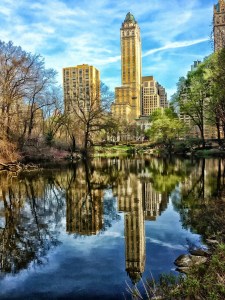 Background: When we build ponds in urban areas, they can play a number of important roles: managing floodwater, cooling the urban environment, removing pollution, improving the appearance of built-up areas and providing a habitat for wildlife. However, these different functions often require different forms of management, and so urban managers typically prioritise one or a small number of purposes. We were interested in the biodiversity value of ponds in Bradford in the UK.
 Background: The management of water in urban areas can be a problem, because rainfall rapidly runs off impervious surfaces like pavements and roads. This means the water quickly enters rivers and streams, which then flood. City managers reduce the rate at which water enters rivers using stormwater management facilities, which often include ponds to hold back the stormwater. These ponds are usually managed just for water retention, but they could potentially form a very useful habitat for aquatic plants and animals in cities.
 Katatrepsis