
For those of you not familiar with Cordyceps fungus, that’s the one that attacks insects (and other arthropods) by infecting and then spreading through the whole body. The result is something like what you see below:
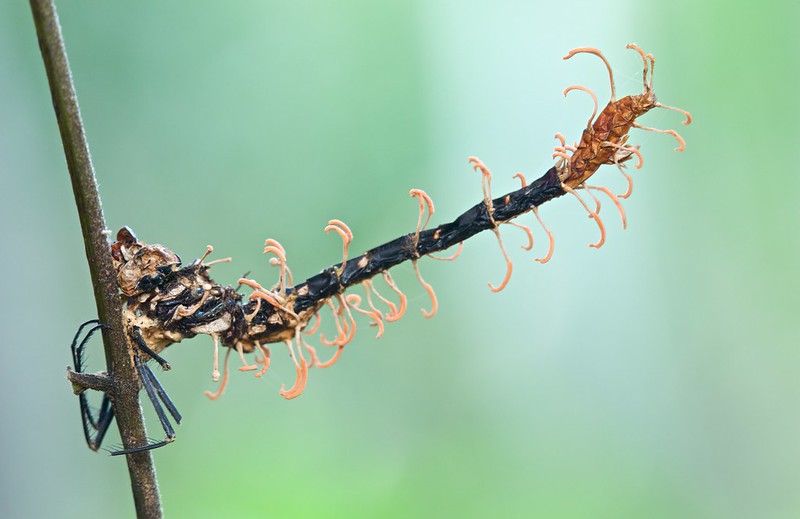
Each one of those little growths is a “fruiting body” and that is where the fungus releases its spores in order to found new patches of fungus. The most famous of these kinds of fungi is perhaps Ophiocordyceps unilateralis, which infects ants and influences their behaviour. The fungus forces an ant to climb a blade of grass or a twig and then attach there until it dies. Meanwhile the fungus produces a series of fruiting bodies that release spores from the new vantage point – the height helps those spores to disperse a greater distance. Apparently fossilised plants from 50m years ago also bear the marks of these Cordyceps-related attachments by insects, suggesting that this is an old battle.
What we don’t know is the extent to which Cordyceps influences the behaviour of other hosts. I posted the image above because it is the first time that I have seen a dragonfly infected in this way. It would make more sense (to me, at least!) for Cordyceps infecting a dragonfly to make it fly upwards while the fruiting bodies are releasing spores to broadcast those offspring as far as possible. However, the only image I have seen is this one where the animal is firmly rooted to the perch.
If it was a parasite that affected dragonfly flight then it wouldn’t be the first. A few recent studies (e.g. Suhonen et al. 2010) have suggested that dragonflies infected with parasitic mites that cling to the outside of the animal result in greater movement. It has been suggested that this could be an attempt to get out of an area with a high parasite population – after all, that’s not a great place to raise your little dragonfly family. However, we think this response has evolved to help the host and not the parasite, which is the opposite to the response elicited by the manipulative Cordyceps.
References
Suhonen, J., Honkavaara, J., Rantala, M.J. (2010) Activation of the immune system promotes insect dispersal in the wild, Oecologia, 162 (3): 541-547.
Image credit: Paul Bertner, https://flic.kr/p/qodUNR, all rights reserved, used with permission.
 Something strange seems to be happening in one particular species of damselfly, the common blue jewel
  Background: Body size is among the most important characteristics of animals and plants. Larger animals are capable of buffering against their environment (think big polar bear vs tiny chihuahua in the snow!) so that they can survive in a wider range of locations, are capable of eating a wider range of prey, and consume more prey than smaller animals leading to a stronger impact on ecosystems. However, we are still trying to understand the factors that influence body size, both ecologically and evolutionarily.
 Background: It is thought that all animals age: they show an increased probability of death at greater ages. However, the lifespans of many animals vary widely. What is it that determines whether or not an animal lives for one year or one hundred years? One of the key drivers is thought to be how likely you are to be killed by something else. Those animals that that are unlikely to be eaten, whether that is because they are very large (elephants), well armoured (tortoises) or poisonous (poison dart frogs), tend to evolve lower rates of ageing. After all, if you are going to live for a long time anyway, you might as well make the most of it. On the other hand, if you live precariously from day to day then there isn’t much point in investing later in life because you probably won’t get that far.
 Background: As well as publishing in ecology and evolutionary biology, I am also interested in how that publishing industry works. There is a clear need to disseminate information as widely as possible in order to accelerate the rate of testing of new theories and discovery of new information. However, some publishing models (and some publishing companies) hide scientific research away so that most people do not have access to that work. Self-archiving is a way for researchers to make available certain forms of their research without breaking copyright (which is almost always handed over to the publishers).
 Background: There are a number of ways in which animals and plants attempt to defend themselves from predators. Sometimes they look or sound like something that they are not, such as another animal or plant that is venomous, in a process known as “mimicry”. Other times, rather than attempting to deceive a predator after being seen, the animal or plant might try to hide altogether. This second defensive strategy, known as “camouflage”, can take a number of forms. One of the most interesting forms of camouflage is “disruptive colouration” which involves breaking up the edge of an animal to make it harder to detect.
 Background: A large number of species are expanding their ranges in response to climate change. This is also true in the damselflies, where the small red-eyed damselfly (Erythromma viridulum) has recently (around 1998) crossed the sea from France to England. Since then, the species has moved hundreds of kilometres north in an unprecedented range expansion (at least as far as European dragonflies and damselflies are concerned). What is less clear is what impact this expansion has had on the species. Are the newly-founded populations the same as those that are resident in France? Can we trace the arrival and expansion of the species through genetic techniques?
 Background: Animals and plants can benefit by resembling other species. For example, some plants have spots that look like ants to deter herbivores, cuckoos look like hawks to frighten smaller birds from their nests, and harmless snakes have striped bodies that resemble highly venomous species. However, there are other modes of resemblance: animals and plants can smell, sound or act like another species in addition to (or instead of) having visual resemblance. However, we don’t know much about how different types of mimicry interact in the wild.
 Background: Urban ecosystems are becoming increasingly important as areas for biodiversity conservation, as we begin to recognise the importance of preserving natural habitat within heavily modified environments for both wildlife and human well being. Urban ponds are a key part of this network of habitats within cities, and are commonly found in parks, gardens and industrial estates. In fact, there are an estimated 2.5-3.5 million garden ponds in the UK alone, which could have an area the size of Lake Windermere!
 Katatrepsis