British dragonflies are emerging earlier in the year under climate change

Background: A variety of responses to climate change have been detected in a variety of taxa.  Among these is a change in phenology – the timing of the life cycle (like the emergence of an adult dragonfly from its larval case as shown on the right). Since some species use temperature as a cue for when to develop, as the environment warms there is a signal of earlier development in these species.

What we did: I analysed an extensive dataset of sightings of dragonflies and damselflies (Odonata) over a 50-year period in the UK.  These 450,000 sightings were of around 40 species and provided a detailed record of dates on which different Odonata species were emerging from their aquatic habitats.  I found that there was a significant shift towards earlier emergence which was consistent with that observed in terrestrial species.  I further demonstrated that there was a difference between two groups of species that varied in what stage they over-wintered.  Those species that sat in the water over winter as eggs did not show a response to climate change while those that were larvae over winter did show a response.  I infer from this that the response to climate change is caused by a decline in mortality associated with cooler temperatures in the more vulnerable larval stages.

Importance: As I mention above, a number of studies have demonstrated an effect of climate change on the phenology of animals and plants.  This study showed that the signal was present even for animals that occupy aquatic habitats, suggesting that temperature changes influences aquatic and terrestrial ecosystems in much the same way.


This is part of a series of short lay summaries that describe the technical publications I have authored. This paper, entitled “Historical changes in the phenology of British Odonata are related to climate”, was published in the journal Global Change Biology in 2007 (my first paper!). You can find this paper online at the publisher, or on Figshare.

Image credit: Sally Crossthwaite, CC BY-NC-ND 2.0, http://bit.ly/1q6HYtH

Who would win in a fight between a rhino and a tiger?

tigerrhinoI got an email from our university press officer earlier this week asking “whether we have a ‘zoologist who could participate in a light-hearted discussion about who would win in a fight between a tiger and a rhino on Friday morning’.” The request was from the local BBC Radio Leeds team who wanted to break up their coverage of the Leeds Rhinos vs Castleford Tigers rugby league Challenge Cup final preparations with some light-hearted digressions. I have resolved to take a more active part in science communication (including this blog), because I see that as a fundamental part of my job (even if it is little-rewarded…) and so I agreed to do it.Read More »

Study design and mark recapture estimates of dispersal [paper summary]

This is part of a series of short lay summaries that describe the technical publications I have authored.  This paper, entitled “Study design and mark recapture estimates of dispersal: A case study with the endangered damselfly Coenagrion mercuriale”, was published in the Journal of Insect Conservation in 2012. You can find this paper online at the publisher, or on Figshare.

9303167014_cdbcb32d61_zBackground:  I have long been interested by movement of animals in the landscape and whether or not this can be accurately quantified in the field.  One of the major issues associated with these field studies (such as mark-release-recapture studies, in which animals are marked with a unique tag then recaptured at a later time) is that you cannot detect dispersal distances that are greater than the size of the study area that you are using.  For example, people have been marking damselflies for decades to try to measure how far they fly.  However, if you only look for them 500m from where you first found them, you won’t find them flying any further than that.

What we did: This study used a large mark-release-recapture dataset and investigated the effect that expanding a study area has on the maximum dispersal distance detected.  We found that the original study (on the endangered southern damselfly, Coenagrion mercuriale) was at a scale sufficient to estimate the maximum distance that the insect is able to fly, around 2km.

Importance: This endangered species has very specific habitat requirements (water meadows and shallow ditch systems) which mean that it has a long distance to move between these rare areas.


Image credit: Paul Ritchie, CC BY-NC-ND 2.0, http://bit.ly/1sZpjCC

“Data from above” – quadcopters and thermal imaging in ecology

I’ve been interested in small-scale variation in temperature for sometime, having worked on the impacts of thermal variation on dragonflies for my PhD. However, measuring temperature is a complicated task… Where do you measure? How often? What time of day? I have been thinking about this kind of thing when I started coming across Public Lab projects that were conducting aerial surveys using balloons. That got me thinking about flying, and before you know it I’ve pinched a colleague’s quadcopter and we’re flying (cautiously) around the University of Leeds campus:

Read More »

Clayton Woods and Woodside Quarry

I’m lucky to live in one of the leafier parts of Leeds, and there is a reasonable amount of green space within an hour’s walk from my home. Yesterday I made my first visit to one such area: Clayton Woods, which turned out to be much more interesting than I was expecting. The woods themselves are pleasant enough to walk through – small dirt tracks weaving through trees and speckled with boulders. There is enough tree cover that the sound from the nearby road is almost blotted out. However, what was most fascinating was what lies at the centre: an abandoned quarry. I had heard about this quarry, but there doesn’t seem to be much information on it aside from a small number of mentions on web forums about the Leeds area. I thought it was worth trying to pull some of that information together here in one place.Read More »

Good mimics have the costumes and the acting skills

There are lots of ways to fool an observer, and I mentioned quite a few in my post on the Cafe Scientifique talk that I gave in September. However, one aspect that I didn’t mention there was “behavioural mimicry” – where an animal acts like another animal in order to fool a potential predator or prey.  This sort of behaviour has been reported plenty of times in the field, but has never been studied in a systematic way. My collaborators over at Carleton (led by Tom Sherratt and Heather Penney, who collected the data as part of her MSc thesis work) and I have just published a paper (press release here) which provides just such an overview, and tests a few key evolutionary hypotheses along the way.Read More »

I did a map!

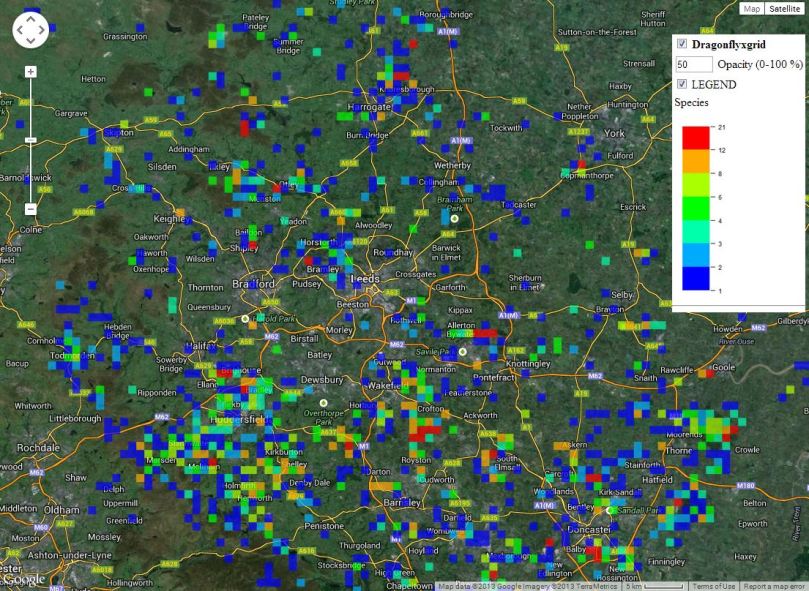
I have been playing with R’s capacity to produce interactive maps and (after much trial-and-error) have finally come up with something that shows an interesting pattern.  The data plotted below are the species richness of dragonflies and damselflies from the British Dragonfly Society‘s database in West Yorkshire over the last 20 years.  The data are summarised to 1km grid squares on the British National Grid.  Below is a screenshot because WordPress doesn’t like iframes, but click it to go to the full map.

Capture

The scale is a bit odd to emphasise the range of the data, and there are many neater ways to do this.  In particular, R gives the option to render in interactive 3D using OpenGL, create actual interactive maps using Shiny, and use the Leaflet jscript packages.  There are more details on the plotGoogleMaps package that I used for this little map here.  The code is below:

Dragonfly.grid <- read.table("Dragonfly data.txt",header=TRUE)
attach(Dragonfly.grid)
Dragonfly.grid[,2]<-Dragonfly.grid[,2]*100
Dragonfly.grid[,3]<-Dragonfly.grid[,3]*100
library(RColorBrewer)
coordinates(Dragonfly.grid)<-c('Easting','Northing')
Dragonfly.grid<-as(Dragonfly.grid,'SpatialPixelsDataFrame')
proj4string(Dragonfly.grid) <- CRS('+proj=tmerc +lat_0=49 +lon_0=-2 +k=0.9996012717 +x_0=400000 +y_0=-100000 +ellps=airy +datum=OSGB36 +units=m +no_defs')
m=plotGoogleMaps(Dragonfly.grid,zcol='Species',at=c(0,2,3,4,6,8,12,21),colPalette= rev(rainbow(7,start=0,end=4/6)))

Created by Pretty R at inside-R.org

PhD opportunities in ecology and evolution

As part of the new NERC Doctoral Training Program at the University of Leeds, I have two PhD projects to advertise that are now (as of 15th November 2013) open to applicants:

1: DragonFlight: Linking the mechanics and energetics of flight to conservation status and responses to climate change in dragonflies

dragonfly-177338_1280The DragonFlight project builds on my earlier interests in dragonfly dispersal (1), macroecology (2), and flight morphology (3).  There has quite a bit of work done on the flight of dragonflies, but much of this has taken place in the laboratory and has not considered what goes on in the field.  Similarly, there has been quite a lot of landscape-scale work done in the form of mark-recapture studies or analyses of historical records (including my own), but none of this has really tested for the traits that underlie flight ability.  This project will link detailed biomechanical measurements of dragonfly flight to our knowledge of responses to climate change (i.e. range shifts) or conservation status.

2: Teaching old beetles new tricks: applying novel genetic techniques to re-establish a classic ecological model system, Tribolium

I’m really excited about this project.  Andrew Peel, a colleague at Leeds, has been working on the evolution of beetles (and animals in general) for a while and uses Tribolium as a model system.  I have been interested in the ecology of this system for some time and this project represents us banging our brains together. In particular, there are lots of nice ways that we can incorporate Andrew’s contemporary genomic techniques (e.g. RNAi) to test for genetic drivers of ecological phenomena.  The species is also an important pest species of stored grain, making any advances potentially applicable to pest control.
Note that both of these are “competitively funded”, which means that there are more projects than we can fund.  We interview candidates for all projects and then award the best candidates the projects that they applied for.  There are more details on the website, including how to apply.  Deadline is 24th January 2014.


References:
(1) Hassall C, Thompson DJ (2012) Study design and mark recapture estimates of dispersal: a case study with the endangered damselfly Coenagrion mercuriale. Journal of Insect Conservation, 16, 111-120.
(2) Hassall C, Thompson DJ (2010) Accounting for recorder effort in the detection of range shifts from historical data. Methods in Ecology and Evolution, 1, 343-350.
(3) Hassall C, Thompson DJ, Harvey IF (2008) Latitudinal variation in morphology in two sympatric damselfly species with contrasting range dynamics (Odonata: Coenagrionidae). European Journal of Entomology, 105, 939-944.

Communicating camouflage and mimicry: chocolate, hover flies and Teddy Roosevelt

BTo0JXhIUAA3dEE

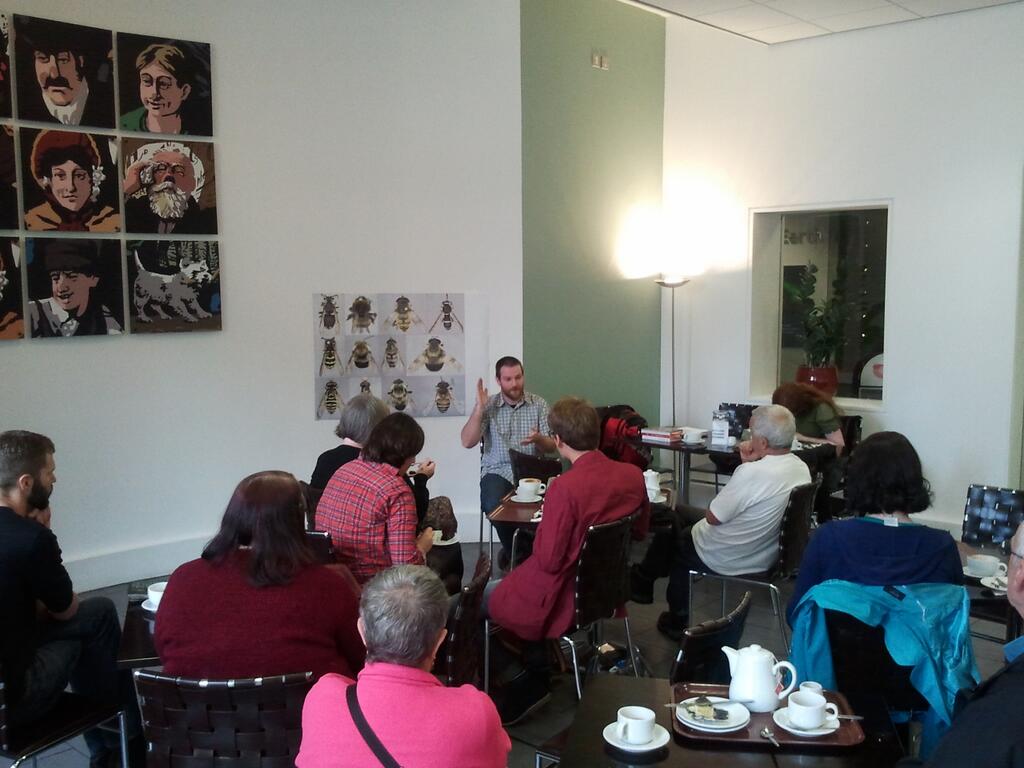
In September I gave a Cafe Scientifique talk at the Leeds City Museum on the evolution of mimicry and camouflage.  For those of you who aren’t familiar with the concept, Cafe Scientifique offers an opportunity for scientists to give short (or long, depending on how it is run) talks on their research to a general audience and then take questions in an informal setting.  I have always been a fan of this kind of outreach, and when Clare Brown, the curator of Natural History at Leeds Museum asked if I wanted to give a talk I jumped at the opportunity.  I spent a bit of time pulling resources together for the talk and I thought I would post them here in case anybody else could find a use for them.  I have outlined the talk I gave below:Read More »

“Camouflage on the edge” – a new paper on concealing colouration

In 2012, the US Government cancelled a $5 billion camouflage project under which it had already supplied uniforms to soldiers in Afghanistan.  The pattern of camouflage, called the “universal camouflage pattern” (UCP) was supposed to allow soldiers to blend in equally well in forests, deserts, and urban environments but had been deployed but never properly tested to ensure that it provided proper protection.  When this testing was finally carried out, it demonstrated that the camouflage performed poorly, and was actually putting soldiers at unnecessary risk.  It got so bad that US Army soldiers were trading their uniforms with locals so that they could wear something with appropriate colouration.  What this goes to show is how poorly we understand the mechanisms underlying camouflage, even while we spend enormous amounts of money attempting to exploit the phenomenon.  A new paper that my colleagues (based at Carleton University) and I published today in the Royal Society journal Biology Letters adds a key piece to the camouflage puzzle by illustrating for the first time the mechanism behind “disruptive colouration“.  The paper can be viewed for free at the journal homepage, as can all Biology Letters articles, until 30th November 2013 – go browse, it’s a fascinating journal with short, varied, interesting papers.

Read More »