I did a map!

I have been playing with R’s capacity to produce interactive maps and (after much trial-and-error) have finally come up with something that shows an interesting pattern.  The data plotted below are the species richness of dragonflies and damselflies from the British Dragonfly Society‘s database in West Yorkshire over the last 20 years.  The data are summarised to 1km grid squares on the British National Grid.  Below is a screenshot because WordPress doesn’t like iframes, but click it to go to the full map.
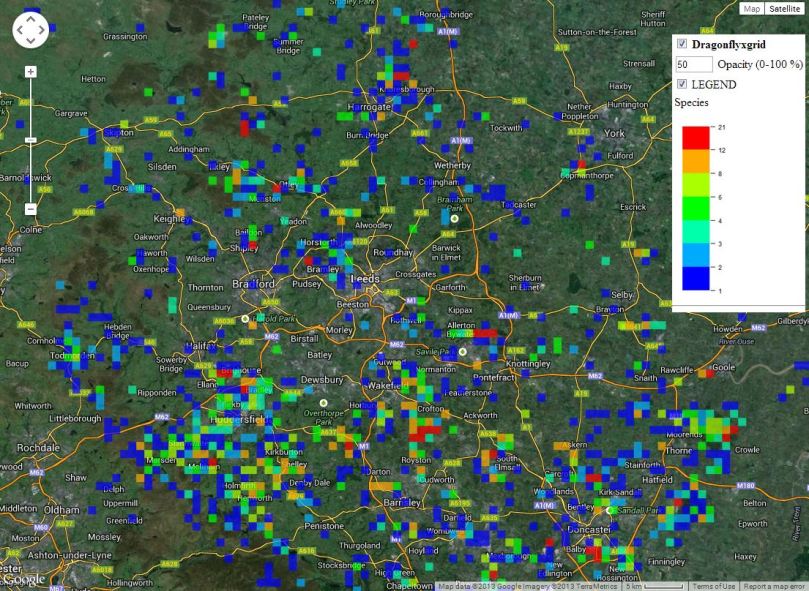
Capture

The scale is a bit odd to emphasise the range of the data, and there are many neater ways to do this.  In particular, R gives the option to render in interactive 3D using OpenGL, create actual interactive maps using Shiny, and use the Leaflet jscript packages.  There are more details on the plotGoogleMaps package that I used for this little map here.  The code is below:

Dragonfly.grid <- read.table("Dragonfly data.txt",header=TRUE)
attach(Dragonfly.grid)
Dragonfly.grid[,2]<-Dragonfly.grid[,2]*100
Dragonfly.grid[,3]<-Dragonfly.grid[,3]*100
library(RColorBrewer)
coordinates(Dragonfly.grid)<-c('Easting','Northing')
Dragonfly.grid<-as(Dragonfly.grid,'SpatialPixelsDataFrame')
proj4string(Dragonfly.grid) <- CRS('+proj=tmerc +lat_0=49 +lon_0=-2 +k=0.9996012717 +x_0=400000 +y_0=-100000 +ellps=airy +datum=OSGB36 +units=m +no_defs')
m=plotGoogleMaps(Dragonfly.grid,zcol='Species',at=c(0,2,3,4,6,8,12,21),colPalette= rev(rainbow(7,start=0,end=4/6)))

Created by Pretty R at inside-R.org

PhD opportunities in ecology and evolution

As part of the new NERC Doctoral Training Program at the University of Leeds, I have two PhD projects to advertise that are now (as of 15th November 2013) open to applicants:

1: DragonFlight: Linking the mechanics and energetics of flight to conservation status and responses to climate change in dragonflies

dragonfly-177338_1280The DragonFlight project builds on my earlier interests in dragonfly dispersal (1), macroecology (2), and flight morphology (3).  There has quite a bit of work done on the flight of dragonflies, but much of this has taken place in the laboratory and has not considered what goes on in the field.  Similarly, there has been quite a lot of landscape-scale work done in the form of mark-recapture studies or analyses of historical records (including my own), but none of this has really tested for the traits that underlie flight ability.  This project will link detailed biomechanical measurements of dragonfly flight to our knowledge of responses to climate change (i.e. range shifts) or conservation status.

2: Teaching old beetles new tricks: applying novel genetic techniques to re-establish a classic ecological model system, Tribolium

I’m really excited about this project.  Andrew Peel, a colleague at Leeds, has been working on the evolution of beetles (and animals in general) for a while and uses Tribolium as a model system.  I have been interested in the ecology of this system for some time and this project represents us banging our brains together. In particular, there are lots of nice ways that we can incorporate Andrew’s contemporary genomic techniques (e.g. RNAi) to test for genetic drivers of ecological phenomena.  The species is also an important pest species of stored grain, making any advances potentially applicable to pest control.
Note that both of these are “competitively funded”, which means that there are more projects than we can fund.  We interview candidates for all projects and then award the best candidates the projects that they applied for.  There are more details on the website, including how to apply.  Deadline is 24th January 2014.


References:
(1) Hassall C, Thompson DJ (2012) Study design and mark recapture estimates of dispersal: a case study with the endangered damselfly Coenagrion mercuriale. Journal of Insect Conservation, 16, 111-120.
(2) Hassall C, Thompson DJ (2010) Accounting for recorder effort in the detection of range shifts from historical data. Methods in Ecology and Evolution, 1, 343-350.
(3) Hassall C, Thompson DJ, Harvey IF (2008) Latitudinal variation in morphology in two sympatric damselfly species with contrasting range dynamics (Odonata: Coenagrionidae). European Journal of Entomology, 105, 939-944.

Communicating camouflage and mimicry: chocolate, hover flies and Teddy Roosevelt

BTo0JXhIUAA3dEE

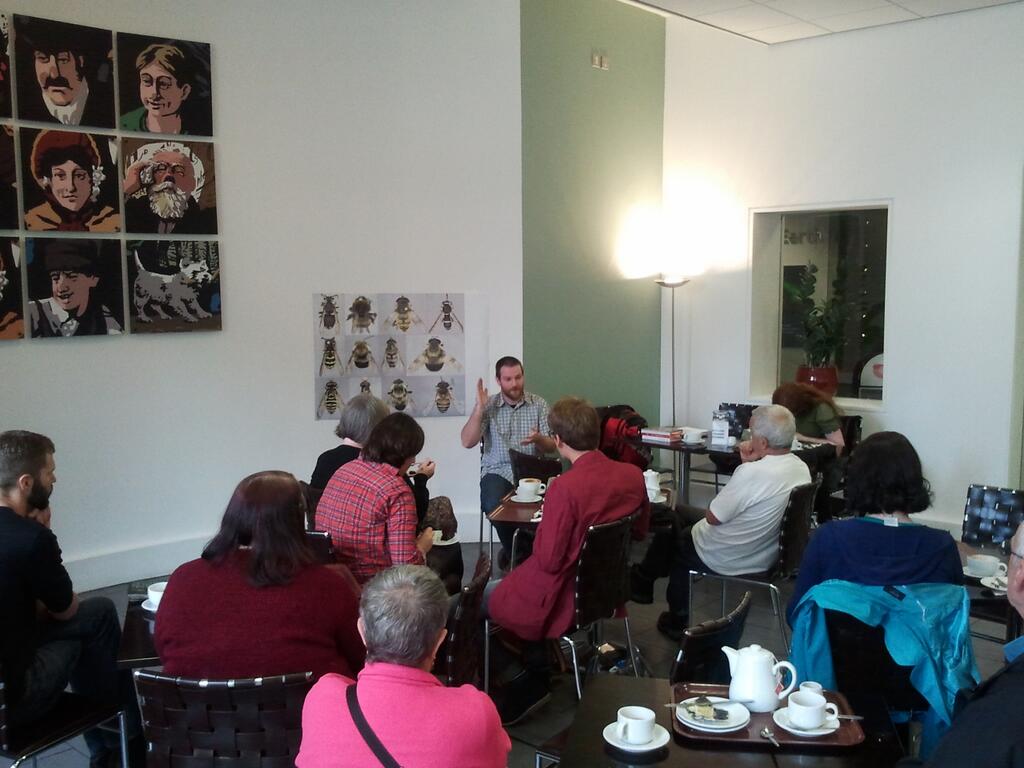
In September I gave a Cafe Scientifique talk at the Leeds City Museum on the evolution of mimicry and camouflage.  For those of you who aren’t familiar with the concept, Cafe Scientifique offers an opportunity for scientists to give short (or long, depending on how it is run) talks on their research to a general audience and then take questions in an informal setting.  I have always been a fan of this kind of outreach, and when Clare Brown, the curator of Natural History at Leeds Museum asked if I wanted to give a talk I jumped at the opportunity.  I spent a bit of time pulling resources together for the talk and I thought I would post them here in case anybody else could find a use for them.  I have outlined the talk I gave below:Read More »

“Camouflage on the edge” – a new paper on concealing colouration

In 2012, the US Government cancelled a $5 billion camouflage project under which it had already supplied uniforms to soldiers in Afghanistan.  The pattern of camouflage, called the “universal camouflage pattern” (UCP) was supposed to allow soldiers to blend in equally well in forests, deserts, and urban environments but had been deployed but never properly tested to ensure that it provided proper protection.  When this testing was finally carried out, it demonstrated that the camouflage performed poorly, and was actually putting soldiers at unnecessary risk.  It got so bad that US Army soldiers were trading their uniforms with locals so that they could wear something with appropriate colouration.  What this goes to show is how poorly we understand the mechanisms underlying camouflage, even while we spend enormous amounts of money attempting to exploit the phenomenon.  A new paper that my colleagues (based at Carleton University) and I published today in the Royal Society journal Biology Letters adds a key piece to the camouflage puzzle by illustrating for the first time the mechanism behind “disruptive colouration“.  The paper can be viewed for free at the journal homepage, as can all Biology Letters articles, until 30th November 2013 – go browse, it’s a fascinating journal with short, varied, interesting papers.

Read More »

The first female entomologist: Maria Sibylla Merian

Maria Sibylla Merian (1647-1717)

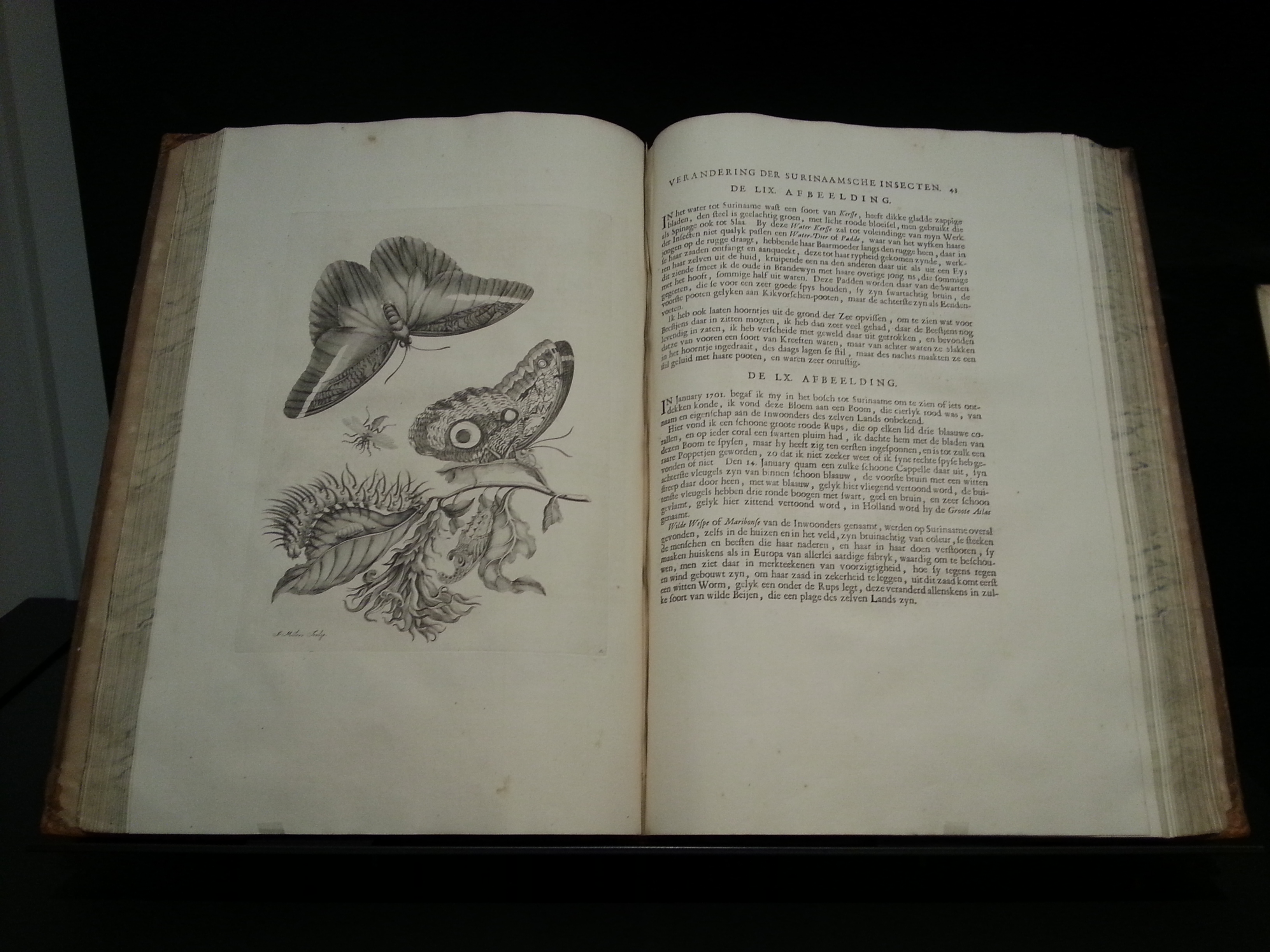
I recently visited Amsterdam, where I came across the work of a German naturalist of whom I had not previously been aware.  The Rijksmuseum contains a book that dates back to 1730 and was written by (according to the museum plaque) the “first female entomologist”, Maria Sibylla Merian (1647-1717). The book, entitled De Europische Insecten (available online through the Biodiversity Heritage Library) contains hundreds of illustrations of species made by the author (who also happened to be an extremely talented artist).  You can see some of the detailed illustrations from the book at the Sotheby’s auction page for a copy that is for sale (at £25,000-30,000 it’s a bit out of my price range…) and an example of a page below.

A plate from De Europische Insecten

Merian’s story is an interesting one.  Born into a famous publishing family, her father passed away when she was three years old.  Her mother later married an artist, thus combining the literary and artistic aspects of Merian’s upbringing that would determine her career.  She began at the age of 13 by drawing and painting the silk worms that she caught around her home in Frankfurt.  As a young female artist, she was a popular tutor for the daughters of local wealthy families and this allowed her to both earn a good living and gain access to influential people (and their extensive gardens with all those wonderful insects!).  It was as a result of watching the development of caterpillars into butterflies that she became interested in metamorphosis, and this eventually led to her publication of Metamorphosis insectorum Surinamensium (also available online in its entirety).  This volume, drafted by Merian after a two year visit to the Dutch colony of Surinam in South America (which was cut short after she caught malaria), provided European scientists with some of the first full-colour images of the South American flora and fauna.  Merian undertook that trip at the age of 52 with her daughter, Dorothea Maria, and documented many new species of Lepidoptera, including all stages of the life cycle and the host plant on which the caterpillar lives – a wonderful resource for naturalists back home.  During her visit to Surinam, Merian spoke out against the mistreatment of slaves by Dutch plantation owners and took note of the names that indigenous peoples gave to the species she encountered.

Merian’s work was extremely valuable to Carl Linnaeus, who published in 1735 his Systema Naturae (also available online, but nowhere near as aesthetically appealing at Merian’s work) which laid-out the biological nomenclature that we use today.  In particular, the focus on metamorphosis has led to her being listed among the most influential entomologists of all time.  Merian was honoured with a Google Doodle to commemorate what would have been her 366th birthday on 3rd April 2013.  However, despite all this there is a pretty good chance that Merian died penniless in 1717 a few years after suffering a stroke.  But that is all the more reason to appreciate her work today, which is still among some of the most-highly valued and collectable natural history artwork in the world.

2013-05-03 16.15.00
The copy of De Europische Insecten in the Rijksmuseum, Amsterdam