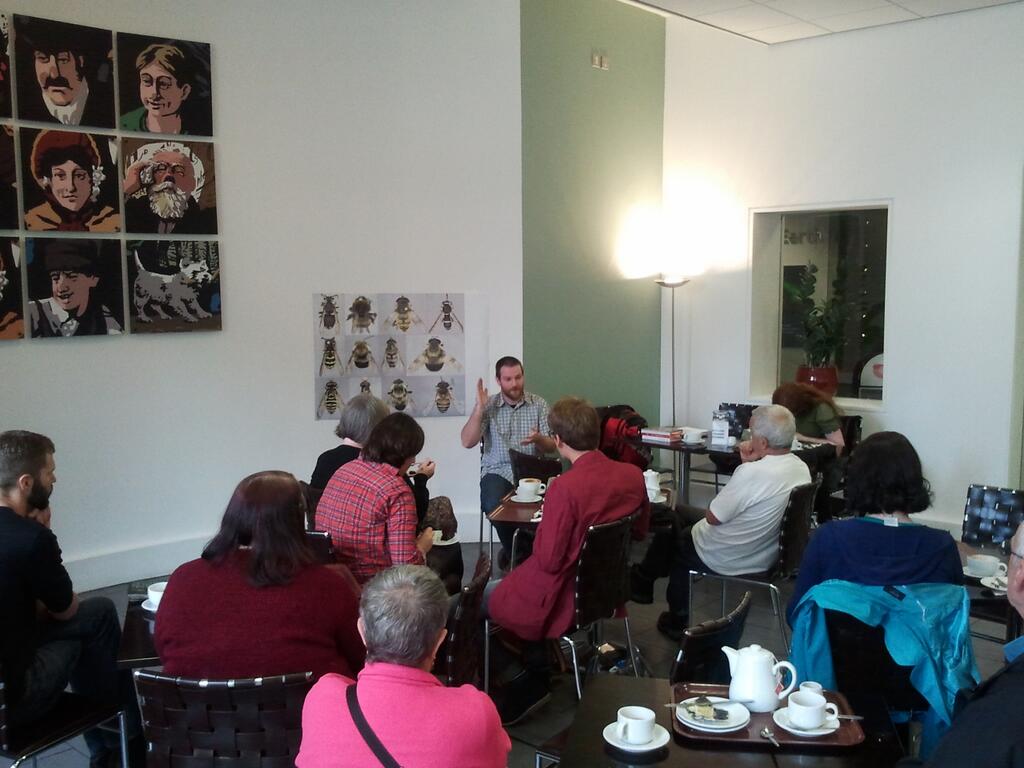
In September I gave a Cafe Scientifique talk at the Leeds City Museum on the evolution of mimicry and camouflage. For those of you who aren’t familiar with the concept, Cafe Scientifique offers an opportunity for scientists to give short (or long, depending on how it is run) talks on their research to a general audience and then take questions in an informal setting. I have always been a fan of this kind of outreach, and when Clare Brown, the curator of Natural History at Leeds Museum asked if I wanted to give a talk I jumped at the opportunity. I spent a bit of time pulling resources together for the talk and I thought I would post them here in case anybody else could find a use for them. I have outlined the talk I gave below:Read More »
Category: evolution
“Camouflage on the edge” – a new paper on concealing colouration
In 2012, the US Government cancelled a $5 billion camouflage project under which it had already supplied uniforms to soldiers in Afghanistan. The pattern of camouflage, called the “universal camouflage pattern” (UCP) was supposed to allow soldiers to blend in equally well in forests, deserts, and urban environments but had been deployed but never properly tested to ensure that it provided proper protection. When this testing was finally carried out, it demonstrated that the camouflage performed poorly, and was actually putting soldiers at unnecessary risk. It got so bad that US Army soldiers were trading their uniforms with locals so that they could wear something with appropriate colouration. What this goes to show is how poorly we understand the mechanisms underlying camouflage, even while we spend enormous amounts of money attempting to exploit the phenomenon. A new paper that my colleagues (based at Carleton University) and I published today in the Royal Society journal Biology Letters adds a key piece to the camouflage puzzle by illustrating for the first time the mechanism behind “disruptive colouration“. The paper can be viewed for free at the journal homepage, as can all Biology Letters articles, until 30th November 2013 – go browse, it’s a fascinating journal with short, varied, interesting papers.
The perils of predictability
Order is a standard part of nature, from the mathematical patterns found in natural structures to the predictable variation in sunrise times at different times of year. Indeed, animals and plants rely on regular, logical ordering of events. For example, in my work on pollinator ecology bees rely on seasonal patterns in flower blooming as a food source. But this regularity is a double-edged sword: just as a bee can exploit regularity in flowering times, so can birds exploit the regularity in bee occurrence. A shared synchrony of life cycles brings costs and benefits. And this is where we bring in the Greek sea-god Proteus (pictured right). Proteus was a god who was able to change his form to avoid having to tell the future, and he has given his name to “protean” phenomena – those phenomena that are changeable or unpredictable. We can see a potential benefit in the plants altering their timing of flowering (of exhibiting protean flowering patterns) – if they remain predictable then the bees on which they rely for pollination are also predictable, which means that they are easy to exploit as food for birds. However, unpredictable flowering times might result in flowers occurring when there are no pollinators, which would be bad for both groups. Synchrony in the seasonality of flowers, insects, and birds is a complex association between populations (or even communities) of animals, and this makes evolutionary change slow.Read More »
Species with a chemical defence (but not a chemical offence) live longer

I wanted to spend a post talking about a new paper that was published recently (3 May 2013) with some colleagues from Carleton University. It is easy to see the value of tasting bad: predators try to eat you, feel sick, then leave you alone. Even better if you have bright colours or a strong smell (called “aposematic signals”) to go along with it – that way predators can learn to avoid your colours without having to taste you a second time. In fact, they don’t have to taste you at all if other animals of your species also have the bad taste and the bright colours. In theory, this chemical defence should reduce deaths due to predation which means that the prey live longer.Read More »
My PhD thesis in the ten hundred most used words
Inspired by this xkcd comic, and facilitated by this online tool, people have been summarising all kinds of ideas using the 1,000 most common words. Naturally PhD students have latched onto this as a source of procrastination and, in a show of solidarity, I decided to join them (this was during my lunch break – honest!). Here’s my PhD thesis:
My work looks at how animals change as the world gets warmer. My animal is like a fly but it has four flying bits, eats other animals, and has big eyes. By looking at where people saw these animals in the past, I figured out how the place and time at which they appear changes with how hot it is. I found that they appear earlier when it is hot, which is interesting because these animals spend most of their lives in water. Animals in water had not been shown to change when they appear in this way before. I also looked at the ways in which we look at changes in where animals appear and showed the best way to look at this problem. Last, I looked at how the form of these animals changes as they move when it gets hotter. I found that the animals that had moved a long way had a form that made it easy for them to move (like big flying bits). In short, the changes shown by the animals that I looked at can be used to build a case for a warming world.
PhD opportunities for UK/EU/International students at the University of Leeds
There are a couple of PhD opportunities coming up in my department at the University of Leeds for UK/EU/international students. Anyone who is interested, or knows someone who might be, get in touch. Areas of interest are around (i) insect ecology/evolution, (ii) biological responses to climate change, or (iii) aquatic ecology. The competition is fierce, but you have to be in it to win it! Get in touch if you are interested in applying and we can discuss ideas.Read More »
Do all species age?
Dragonfly intestines: nature’s Swiss Army knife
“We should be extremely cautious in concluding that an organ could not have been formed by transitional gradations of some kind. Numerous cases could be given amongst the lower animals of the same organ performing at the same time wholly distinct functions; thus in the larva of the dragonfly… the alimentary canal respires, digests and excretes.”
– Charles Darwin, Origin of the Species, Chapter 6Read More »
Does the contraceptive pill affect female mate choice in humans?
In the final Reality Check episode (#208) with which I was involved, I presented a segment on whether or not the contraceptive pill influences women’s perceptions of potential partners. I’ve been interested in this question for a few years, ever since sharing an office with evolutionary psychologists at the University of Liverpool. Craig Roberts, whose work I cited a couple of times, was a lecturer there when I was doing my doctoral research. Anyway, on with the show!Read More »


