
I mentioned in an earlier post the experiments of BF Skinner on pigeons. As I said then, the core of his research was experimenting with learning in animals and the extent to which certain behaviours could be “conditioned”. Now, scientists are constantly asked for examples of applications of their research. Indeed, it is becoming increasingly difficult to obtain funding for projects that do not have some form of tangible output. Faced with this question, Skinner came up with an innovative application of pigeon learning which became known as “Project Pigeon” (or “Project Orcon” for “organic control”).
Read More »
Tag: science
In search of Nessy
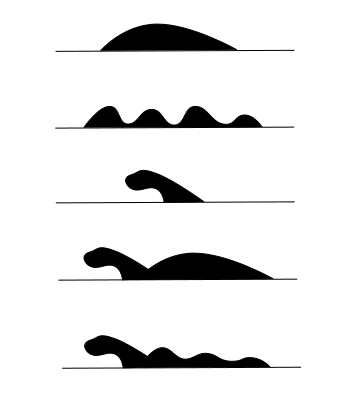
I discussed the application of “climate space envelope models” (also known as “species distribution models” or “ecological niche models”) to Sasquatch in an earlier post. While I was writing that post I was racking my brain trying to remember a scientific paper on the Loch Ness Monster… I distinctly remembered hearing about it in an undergraduate course but didn’t have any record of it in my notes. The good news is I found the paper! In fact, I found several!
Science meets science fiction (and fans)

While some people were off enjoying the sights and sounds of Las Vegas at TAM9, myself and three other members of the Committee for the Advancement of Scientific Skepticism (which bears the much-needed acronym of CASS) were in Toronto having our own little skeptical conference. This is my brief summary of the talks.
In search of Sasquatch
I have been involved in “climate space modelling” for a few years now. This is an approach that uses observations of a given species to determine the range of environmental variables under which it will occur. Once you know what the limits of its tolerance are, you can predict where the species will occur. For example, let’s say that a damselfly (of course I’m using a hypothetical damselfly) can live at temperature of between 10 and 20 degrees and precipitation has to be between 200mm and 500mm per year. Warmer, wetter, cooler or drier than that and it can’t survive. We can use these limits to predict (i) where the species currently exists but has not been recorded, and (ii) where the species might exist in the future as the climate changes.
 Katatrepsis