
I wrote earlier about a few apps that I had found useful in my first weeks of owning an iPad. Well I’ve been actively pursuing opportunities to learn more about the learning applications for tablets like the iPad and wanted to share some of what I have found. A lot of this comes from a workshop by the brilliant Joe Moretti, who came to my university to run a workshop on iPads in education. I hope these are useful to you, too:Read More »
Flipping the classroom – how to make lectures engaging and interactive
I’ve been taking a teaching course that requires me to change the way that I teach to explore new techniques. At first it seemed like it was going to be a lot of effort, but it turned out to be a fascinating and enjoyable experience. I was experimenting with a type of teaching called the “flipped [or inverted] classroom“. Here’s how it works:

iPad apps for academics (Part 1)
I have recently joined the Apple club with a new iPad Air – a great machine that is keeping my attention a lot more than my old Android tablet (which is now a bit dog-eared). I thought I would post about a few apps that I have found and that I have found to be useful:Read More »
Funding for academic outreach in biology (and other sciences)
 I recently heard a keynote talk by Sophie Duncan, the Deputy Director of the National Co-ordinating Centre for Public Engagement, and was really impressed by her enthusiasm for embedding outreach and engagement at every stage of research. Sophie pointed out that there are a number of problems with public engagement as it stands:
- There can be a lack of support and reward for good engagement within departments.
- Outreach tends to be centred on the academic, rather than on the public.
- Groups outside of academia tend not to pro-actively seek academic collaborators.Read More »
The Science of the Sunday Assembly
 [From the outset, it’s worth stating that I’m an atheist (in the soft sense), an agnostic (in a firmer sense), but probably best-described as a Humanist]
Humanists, skeptics, and atheists like to pride themselves on being rational and evidence-based. However, the Sunday Assembly (which I have been helping to organise a bit in Leeds) seems to have brought out the worst kind of ignorant twaddle that I have heard from the community in some time. Most of this seems to centre on “you’re doing something that looks a bit like what people do in church, and that makes it bad”. No attempt at understanding why churches do those things, nor why churches have (until recently) been very successful. With that in mind, here is some science behind the Sunday Assembly:Read More »
Peer instruction – interactive teaching in a large lecture class
 I attended a webinar before Christmas that was hosted by Eric Mazur, a well-known Harvard physics professor. Setting aside how exciting it was to have a guest speaker talking live and taking questions from his office in the US, the subject of his talk was really fascinating. Mazur has developed a series of techniques that can change the way we teach and here he was discussing “peer instruction”.Read More »
“Data from above” – quadcopters and thermal imaging in ecology
I’ve been interested in small-scale variation in temperature for sometime, having worked on the impacts of thermal variation on dragonflies for my PhD. However, measuring temperature is a complicated task… Where do you measure? How often? What time of day? I have been thinking about this kind of thing when I started coming across Public Lab projects that were conducting aerial surveys using balloons. That got me thinking about flying, and before you know it I’ve pinched a colleague’s quadcopter and we’re flying (cautiously) around the University of Leeds campus:
Read More »
Clayton Woods and Woodside Quarry
I’m lucky to live in one of the leafier parts of Leeds, and there is a reasonable amount of green space within an hour’s walk from my home. Yesterday I made my first visit to one such area: Clayton Woods, which turned out to be much more interesting than I was expecting. The woods themselves are pleasant enough to walk through – small dirt tracks weaving through trees and speckled with boulders. There is enough tree cover that the sound from the nearby road is almost blotted out. However, what was most fascinating was what lies at the centre: an abandoned quarry. I had heard about this quarry, but there doesn’t seem to be much information on it aside from a small number of mentions on web forums about the Leeds area. I thought it was worth trying to pull some of that information together here in one place.Read More »
Good mimics have the costumes and the acting skills
There are lots of ways to fool an observer, and I mentioned quite a few in my post on the Cafe Scientifique talk that I gave in September. However, one aspect that I didn’t mention there was “behavioural mimicry” – where an animal acts like another animal in order to fool a potential predator or prey. This sort of behaviour has been reported plenty of times in the field, but has never been studied in a systematic way. My collaborators over at Carleton (led by Tom Sherratt and Heather Penney, who collected the data as part of her MSc thesis work) and I have just published a paper (press release here) which provides just such an overview, and tests a few key evolutionary hypotheses along the way.Read More »
I did a map!
I have been playing with R’s capacity to produce interactive maps and (after much trial-and-error) have finally come up with something that shows an interesting pattern. The data plotted below are the species richness of dragonflies and damselflies from the British Dragonfly Society‘s database in West Yorkshire over the last 20 years. The data are summarised to 1km grid squares on the British National Grid. Below is a screenshot because WordPress doesn’t like iframes, but click it to go to the full map.
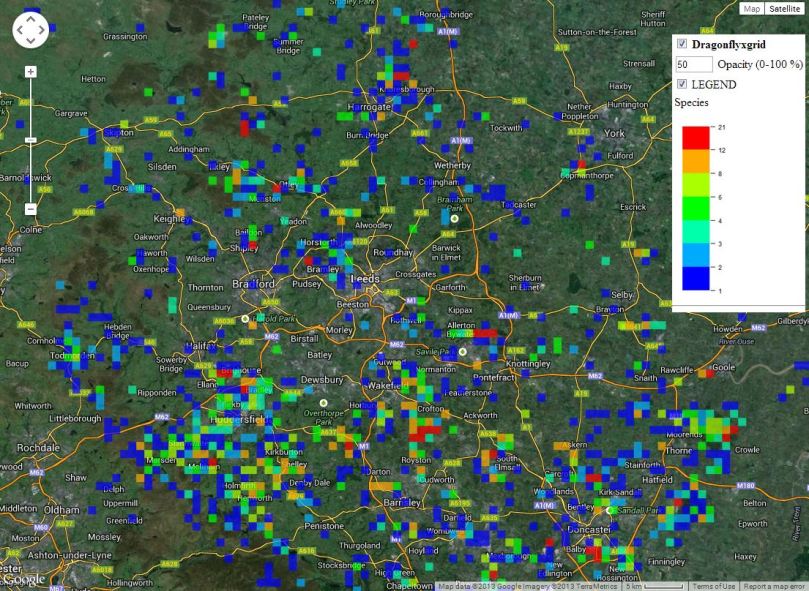
The scale is a bit odd to emphasise the range of the data, and there are many neater ways to do this. In particular, R gives the option to render in interactive 3D using OpenGL, create actual interactive maps using Shiny, and use the Leaflet jscript packages. There are more details on the plotGoogleMaps package that I used for this little map here. The code is below:
Dragonfly.grid <- read.table("Dragonfly data.txt",header=TRUE)
attach(Dragonfly.grid)
Dragonfly.grid[,2]<-Dragonfly.grid[,2]*100
Dragonfly.grid[,3]<-Dragonfly.grid[,3]*100
library(RColorBrewer)
coordinates(Dragonfly.grid)<-c('Easting','Northing')
Dragonfly.grid<-as(Dragonfly.grid,'SpatialPixelsDataFrame')
proj4string(Dragonfly.grid) <- CRS('+proj=tmerc +lat_0=49 +lon_0=-2 +k=0.9996012717 +x_0=400000 +y_0=-100000 +ellps=airy +datum=OSGB36 +units=m +no_defs')
m=plotGoogleMaps(Dragonfly.grid,zcol='Species',at=c(0,2,3,4,6,8,12,21),colPalette= rev(rainbow(7,start=0,end=4/6)))
 Katatrepsis