Citizen science needs fancy statistics to detect the impacts of climate change

Background:  Climate change is causing a range of effects in plants and animals. One of the most noticeable is the colonisation of new areas as the environment warms to a point where animals are able to persist where once they could not. However, the sources of data used to detect these kinds of patterns tend not to be systematically collected and so present unique challenges during analysis. In particular, a lot of existing data on sightings of animals that are used to detect trends under climate change originate from enthusiastic amateurs who make a note of which species they see and where.

What we did: I analysed a series of different methods that have been used to control for the effects of recorder effort bias in the detection of range shifts.  This recorder effort bias occurs when there are far more recorders looking for animals in a later period and so the chance of discovering those extreme populations increases. Thus range shifts could simply be an artefact of increased sampling. I demonstrate that the methods that have been used before vary in the detection of range shifts and that some make more sense than others. I follow this up with a case study on range shifts in British Odonata and make recommendations concerning the most appropriate methods.

Importance: Climate change is an important issue and we need cutting-edge analytical tools if we are to properly assess its impacts on the world. I hope that this paper has contributed to this aim.


This is part of a series of short lay summaries that describe the technical publications I have authored.  This paper, entitled “Accounting for recorder effort in the detection of range shifts from historical data”, was published in the journal Methods in Ecology and Evolution in 2010. You can find this paper for free online at the publisher.

Image credit: Ken Slade, CC BY-NC 2.0, http://bit.ly/1qAae4a

Twitter in teaching

Picture

Twitter is known as a “micro-blogging” site, in the sense that communication through Twitter is restricted to 140 character “tweets”.  Probably as a result of this slightly unusual nature, it is rarely adopted in a teaching framework, but that doesn’t mean that there are not opportunities to use the platform to help students.  Uptake has not been helped by the fact that a relatively small minority of academics are currently using the service, meaning that there is a lack of familiarity.  There is also some jargon that you will needto be familiar with to interactthrough this medium:

  • Hashtags – these are tags denoted by the “#” character that group tweets according to particular topics.  For example, a recently published paper on avian phylogenies might be tagged as #bird #evolution.  This makes it easier for users to find and share relevant content.
  • Retweets – rather than generating all of your own content on Twitter, it is common practice to spread the content created by others.  If someone has posted something you found interesting, you can retweet (designated “RT” within the tweet) to push that back out to your followers.
  • Followers – the people who subscribe to tweets from your account are known as “followers” and you will see the option to “follow” other users on Twitter.  This is the audience for your tweets.

The good thing about Twitter is that there is a lot of information. The bad thing about Twitter is that there is a lot of information. Using Twitter effectively means being able to take what you can from the stream of data without feeling too bad about letting a lot of it slide past. This can be helped by managing lists of users of particular interest, and by using programmes that interface with Twitter, such as Tweetdeck and Hootsuite.

An Example of Use
As part of a tutorial on research methods, a class of eight second year undergraduates are given the table of contents to three leading ecology journals from the past few weeks and are told to find a paper that they are interested in and engage with one of the authors on Twitter.  The exchange should involve questions related to the content of the paper or the authors’ similar work and should fit the format of the medium (140 characters).  The students should submit the Twitter exchange, along with a reflection on the experience and the information that was gathered, as an assignment for marking.  This kind of activity helps the student explore a medium of communication that is rarely emphasised within university education, as well as developing their online personae and potentially networking with important researchers.
Also think about:

  • Using Twitter as a communication tool with the rest of the class (e.g. posting assignment deadlines)
  • Using Twitter in-class, by incorporating a Twitter stream on a screen while teaching.  Students can then interact in real-time.

Computer models can predict where rare species might be found

Background:  Species distribution models (SDMs) have been used for a number of different purposes. This approach involves the mapping of species distributions (like the map shown on the right, for the citrine forktail damselfly) onto environmental variables to evaluate the contributions of those variables to determining the species range. This knowledge can then be use to predicted where the species will be in the future under climate change. However, another way in which they can be used is to predict in which areas the species has not been found but could potentially exist.

What we did: My study applied SDMs to this latter problem, predicting where 176 species of North American dragonflies and damselflies occur based on the patchy recording that is currently available.  The models fitted reasonably well, which isn’t surprising given the reliance of dragonflies and damselflies on warm, dry weather for their adult stage.  This highlighted areas for which the models predicted species presence but where those species had not been recorded.  I also demonstrated that the patterns of diversity found in North America were consistent with those found in Europe.

Importance: This kind of study can be used to predict where rare or endangered species may have gone undiscovered as well as directing limited conservation efforts towards areas that are likely to have high diversities of animals or plants but have not been properly explored. We can also look for regions that have been under-surveyed and where resources need to be focused.


This is part of a series of short lay summaries that describe the technical publications I have authored.  This paper, entitled “Predicting the distributions of under-recorded Odonata using species distribution models”, was published in the journal Insect Conservation and Diversity in 2012. You can find this paper online at the publisher, or on Figshare.

Image credit: L. B. Tettenborn, CC BY-SA 3.0, http://bit.ly/XHiqce

Website design in teaching

As well as the writing of scientific reports and the giving of presentations, it is useful for students to have experience of communicating in a variety of digital media.  Websites represent one option for the creation of content in a format that is often consumed by students but to which they rarely contribute.  However, modern tools for website design make the creation of web resources extremely easy.  Below I highlight a few of these options (note that there is considerable overlap with the platforms that can be used for blogging which I describe elsewhere).


PictureWeebly is perhaps the easiest web design platform that I have come across.  The founders of Weebly designed the package so that undergraduate students would be able to create a simple, online presence to help them gain jobs after graduation.  There are lots of simple themes that provide attractive, customisable colour schemes and layouts, and everything is controlled through an intuitive GUI.  You don’t even have to look at the code behind it if you don’t want to.  You can also manage particular editing permissions for particular websites so that students can contribute to different projects.  This website is built in Weebly, and having used Drupal (which I wouldn’t recommend for most purposes), Google Sites (see below), and WordPress (see below) I have to say that this offers the best return for the level of knowledge and effort.


Picture

WordPress, while more complex than Weebly, offers greater functionality.  The interface is still intuitive, with WYSIWYG editing and customisable themes, but there are a wide range of additional “plug-ins” that you can download to perform particular tasks.  Wordpress tends to be used primarily for blogging but is also a perfectly workable website platform.

Picture

I have to say that I have always found Google’s website package to be rather too basic for my needs.  The pages can look quite old-fashioned and basic, and it is difficult to make them anything other than plain.  However, the advantage is that the Google Sites tend to be reasonably clear, and if you are asking your students to sign up for services, you can use Google Sites on the same account as Google Docs.

An Example of Use

One approach that I am planning to trial (and I will update this page if/when I manage to get it going) is to ask students to create a website in the classroom.  The idea would be that I would “flip the classroom”, by giving them a recorded lecture to watch from the previous year and asking them to view it prior to the class.  In the class itself I then have the opportunity to engage with the students in a much more interactive way and the students can revisit the lecture material as much as they like.  Beforehand, I would ask the students to bring laptops, tablets or mobile devices.  I am expecting around 80 students in this particular class and I will divide them into 10 groups of 8.  Each group of eight students would be given an endangered species (or taxon) and asked to describe the following:

  1. The biology of the species
  2. The current threats to the species
  3. What we can do to help
  4. Their opinion on the future of the species

Those four categories of information allow the students to break up into pairs to accomplish the task, which they can do using internet resources accessed through their web-enabled devices.  The idea would be that over the two hour session the students would be able to build a comprehensive, referenced web resource that could be used by interested members of the public.  I would also emphasise that the same basic web design techniques can be used for a variety of applications, including to build an online CV for future career searches.

Student blogging

I don’t get many readers, but some people do find my blog and that has led to over 70k views for the past few years. I’m quite pleased with that, and it gives me the encouragement to carry on through the dry spells. However, I remember starting out and not knowing who would ever read (or even find) my blog. Now I have students who are setting out into the blogosphere and writing great material so I thought I would do my bit to send some traffic their way. Here is a quick list of their blogs, vlogs, radio shows and documentaries that I have come across recently:

EcoSapienLogo

EcoSapien – my former student David has been busy working on a number of projects. EcoSapien is a YouTube show dedicated to spreading awareness about conservation and biodiversity, as well as providing resources for teachers to educate school pupils about wildlife.

North Ronaldsay Logo

North Ronaldsay – David was also the mastermind behind a three-part documentary on the Orkney Island of North Ronaldsay. The show covers the history, wildlife, and people of the island with some beautiful nature shots.

Eye On Wildlife Logo

Eye on Wildlife – Emma produces blogs and podcasts focused on wildlife biology and biological conservation. You can also see her talking about How the Internet Can End Global Poverty, from the University of Leeds TEDx event in November 2014 (video should be available here soon).

Simon the Scientist Logo

Simon the Scientist – a mixture of science writing looking at a wide range of (pretty diverse!) topics.

Screen Shot 2014-12-01 at 08.16.42

In Search of Ancestors – Simon (a different Simon, just to confuse us) is currently – at the time of writing – working as a field assistant in South Africa working on a fossil hominid project. This blog catalogues his ideas on hominid evolution.

Roaming Researcher Logo

The Roaming Researcher – Dan and I worked together on his MSc dissertation project. Since finishing his MSc, Dan has been travelling the world working on a wide range of field projects and shares his experiences on his blog.

Weekly Wildlife Watch Logo

Weekly Wildlife Watch – Tania and Gabriella have been running a student radio show on wildlife ecology and conservation for some time and have managed to get some fascinating folk in for interviews. Go listen and share!

If I have missed anybody then please do let me know and I am happy to update!

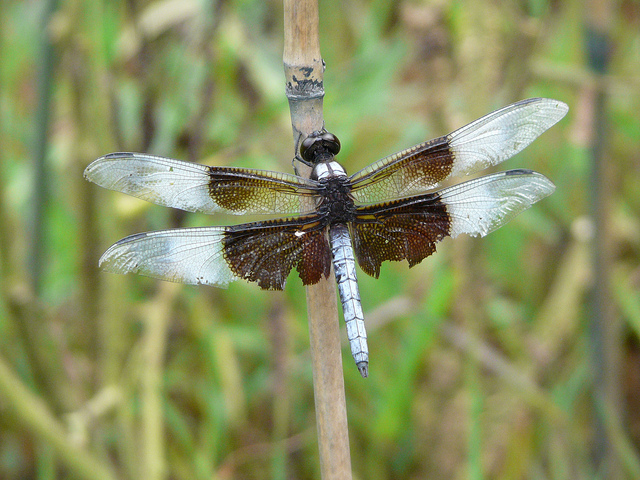
Lots of damselflies age, especially when males compete for territories

Background: When this paper was published, we had already demonstrated that ageing (an increase in the probability of dying in older individuals) was present in one species of damselfly. This was a surprise, as many biologists speculated that short-lived animals like damselflies did not live long enough in the wild to experience ageing. However, anybody who has worked with insects in the field knows that they exhibit clear signs of ageing like the tattered wings of the dragonfly shown above. Having shown that at least one species of damselfly age, it was still unclear as to whether this was the exception or the rule.

What we did: We expanded our analysis from a single species to consider all the species for which there was published data on age-related mortality which we could use to detect ageing.  We found that this phenomenon was present in the vast majority of studies in which we were able to test for it.  Furthermore, we were able to show that it was more apparent in territorial species where males face greater stress in having to defend their territories to obtain mates.

Importance: This study conclusively demonstrated that ageing is commonplace in dragonflies and damselflies, where once it had been proposed that no wild insect populations exhibited ageing at all. We also show a hallmark of the evolution of territoriality in the lifespans of dragonflies and damselflies.


This is part of a series of short lay summaries that describe the technical publications I have authored.  This paper, entitled “A comparative analysis of senescence in adult damselflies and dragonflies”, was published in the Journal of Evolutionary Biology in 2011. You can find this paper online at the publisher, or on Figshare.

Image credit: steews4, CC BY-ND 2.0, http://bit.ly/1rrAEeW

Damselfly sex doesn’t always produce children, and that’s a problem for evolutionary biologists!

Background:  At the core of ecology and evolutionary biology is the concept of “fitness”, broadly defined as the number of copies of an animal’s genes it manages to leave in subsequent generations. However, biologist rarely measure this genetic fitness.  Instead, we use proxies such as the number of times an animal mated or the number of eggs an animal laid. Sometimes, we use proxies that are even further removed, such as body size (under the assumption that larger females lay more eggs).

What we did: This study compared two traditional forms of fitness measurement, daily mating rate and lifetime mating success, with a genetic measure of fitness based on finding the number of offspring each individual produced in the next generation.  We monitored a single, isolated pond over two years and individually identified all damselflies of the species Coenagrion puella, the azure damselfly.  Each individual also had a genetic sample taken and we used genetic markers called “microsatellites” to identify each individual.  When we came back the next year, we did the same thing.  This species goes through one generation per year so we knew that all the animals in the second year were the offspring of those in the first.  By comparing the genetics of the potential parents with those of the potential offspring we were able to assign offspring to parents to produce a much more accurate picture of this concept of “fitness”.  Unfortunately, what we found was that our behavioural measurements did not reflect this more accurate measure of fitness.

Importance: Since the concept of fitness is so important to evolutionary biology, it is important to test the assumptions of the studies that have sought to measure it.  We have demonstrated that some of those previous studies were not using particularly reliable proxies for fitness.  However, we have provided a case study of a potential method for avoiding these problems: by directly genotyping and assigning parents to offspring in the field we can get a much clearer picture of what “fitness” really means.


This is part of a series of short lay summaries that describe the technical publications I have authored.  This paper, entitled “Field estimates of reproductive success in a model insect: behavioural surrogates are poor predictors of fitness”, was published in the journal Ecology Letters in 2011. You can find this paper online at the publisher, or on Figshare.

Image credit: One of mine, CC-BY 3.0

It’s hard to predict how many species a pond might contain…

Background:  Ponds have been identified as a very important habitat in the landscape.  They enhance regional biodiversity, help control floodwater, reduce pollution in run-off from agricultural and urban land, and provide greenspace and biodiversity in urban environments.  However, because of their small size (typically less than two hectares), they have been neglected by scientists until the last couple of decades.

What we did: This study used a large dataset of 454 ponds that had been surveyed in the north of England to identify all of the invertebrate and plant species that inhabited them. A wide range of physical, chemical and biological variables were also measured and, as the title of the paper suggests, we investigated which of these variables were related to the species richness of different plant and animal taxa. We were able to predict a reasonable amount of the diversity of invertebrates in general, but predictions varied between groups of invertebrates. In general, more shade and a history of drying up reduced the diversity of all groups.

Importance: It has been shown that landowners and managers tend to manage ponds and other natural resources using “received knowledge”. in other words, there is little evidence base for such management.  Our study demonstrated a few important relationships which can be used to inform this kind of management.


This is part of a series of short lay summaries that describe the technical publications I have authored.  This paper, entitled “Environmental correlates of plant and invertebrate species richness in ponds”, was published in the journal Biodiversity and Conservation in 2011. You can find this paper online at the publisher, or on Figshare.

Image credit: That’s one of mine, CC-BY 3.0.

Ponds are dynamic habitats, which makes it tough to conserve biodiversity…

Background:  When an area is designated as a site for conservation or special scientific interest that is usually because one or more species of interest have been found or the community as a whole is unique or exceptional. However, the implicit assumption in this approach is that if you come back tomorrow then those species or that community will still be present. If the habitat is dynamic, with frequent population-level extinctions and colonisations, then it may be that this assumption does not hold. Pond ecosystems represent one case where the habitats are small and relatively easily affected by external variables and which may, as a result, vary in their conservation value over time.

What we did: Andrew Hull and Jim Hollinshead have been monitoring ponds in Cheshire (northwest England) for almost 20 years. A set of 51 ponds were surveyed in 1995/6 and again in 2005, meaning that we can test whether or not over this 10-year period there was any change in the conservation value of the ponds. Pond surveys recorded all plant and macroinvertebrate (i.e. invertebrates larger than about 1mm, which was the size of the mesh of the net) species in the ponds and we compared (i) the diversity, and (ii) the conservation value of the ponds between the two surveys. Plants showed similar levels of diversity in both surveys, so highly-diverse ponds in the first survey remained that way in the second. However, invertebrate diversity was not correlated between surveys, meaning that species rich ponds in the first survey did not necessarily remain that way. For both groups there was not correlation between conservation value (calculated based on the rarity of the species in the community) in survey 1 compared to survey 2.

Importance: Ponds are highly variable ecosystems and that is one of the reasons that they support such a wide range of species on a landscape scale. However, it seems that this variability may make it difficult to conserve them adequately, since conservation value is changing over time. This finding supports the conservation of pond clusters, rather than individual sites, which are more likely to contain a stable species pool.


This is part of a series of short lay summaries that describe the technical publications I have authored. This paper, entitled “Temporal dynamics of aquatic communities and implications for pond conservation”, was published in the journal Biodiversity and Conservation in 2012. You can find this paper online at the publisher, or on Figshare.

Image credit: Alison Benbow, CC BY 2.0, http://bit.ly/1l35Tdu

Drones and quadcopters in conservation

I’ve had a bit of a go at using unmanned aerial vehicles (UAVs) in the past (see this little write-up) but with mixed success. Part of the problem is that there has not been any consistent attempt to develop a technology that can be used for environmental or ecological research – just a bunch of scientists trying to MacGyver existing equipment. Now there’s Conservation Drones, who seem to be taking a slight more systematic approach, designing their own drone, spreading the knowledge around, and starting up PhD research projects to develop the tech further. Here’s an early demo of one of their models: