I’ve been interested in small-scale variation in temperature for sometime, having worked on the impacts of thermal variation on dragonflies for my PhD. However, measuring temperature is a complicated task… Where do you measure? How often? What time of day? I have been thinking about this kind of thing when I started coming across Public Lab projects that were conducting aerial surveys using balloons. That got me thinking about flying, and before you know it I’ve pinched a colleague’s quadcopter and we’re flying (cautiously) around the University of Leeds campus:
As part of the new NERC Doctoral Training Program at the University of Leeds, I have two PhD projects to advertise that are now (as of 15th November 2013) open to applicants:
The DragonFlight project builds on my earlier interests in dragonfly dispersal (1), macroecology (2), and flight morphology (3). There has quite a bit of work done on the flight of dragonflies, but much of this has taken place in the laboratory and has not considered what goes on in the field. Similarly, there has been quite a lot of landscape-scale work done in the form of mark-recapture studies or analyses of historical records (including my own), but none of this has really tested for the traits that underlie flight ability. This project will link detailed biomechanical measurements of dragonfly flight to our knowledge of responses to climate change (i.e. range shifts) or conservation status.
I’m really excited about this project. Andrew Peel, a colleague at Leeds, has been working on the evolution of beetles (and animals in general) for a while and uses Tribolium as a model system. I have been interested in the ecology of this system for some time and this project represents us banging our brains together. In particular, there are lots of nice ways that we can incorporate Andrew’s contemporary genomic techniques (e.g. RNAi) to test for genetic drivers of ecological phenomena. The species is also an important pest species of stored grain, making any advances potentially applicable to pest control.
Note that both of these are “competitively funded”, which means that there are more projects than we can fund. We interview candidates for all projects and then award the best candidates the projects that they applied for. There are more details on the website, including how to apply. Deadline is 24th January 2014.
References:
(1) Hassall C, Thompson DJ (2012) Study design and mark recapture estimates of dispersal: a case study with the endangered damselfly Coenagrion mercuriale. Journal of Insect Conservation, 16, 111-120.
(2) Hassall C, Thompson DJ (2010) Accounting for recorder effort in the detection of range shifts from historical data. Methods in Ecology and Evolution, 1, 343-350.
(3) Hassall C, Thompson DJ, Harvey IF (2008) Latitudinal variation in morphology in two sympatric damselfly species with contrasting range dynamics (Odonata: Coenagrionidae). European Journal of Entomology, 105, 939-944.
In September I gave a Cafe Scientifique talk at the Leeds City Museum on the evolution of mimicry and camouflage. For those of you who aren’t familiar with the concept, Cafe Scientifique offers an opportunity for scientists to give short (or long, depending on how it is run) talks on their research to a general audience and then take questions in an informal setting. I have always been a fan of this kind of outreach, and when Clare Brown, the curator of Natural History at Leeds Museum asked if I wanted to give a talk I jumped at the opportunity. I spent a bit of time pulling resources together for the talk and I thought I would post them here in case anybody else could find a use for them. I have outlined the talk I gave below:Read More »
For me, PubMed Commons came out of nowhere. I was aware of some innovations in publishing (check out journals like Cryosphere for examples of progress in academic publishing) but to have a huge group like PubMed involved in pro-actively pushing boundaries is a real game-changer. Here’s why it’s so important: academic publishing as it currently exists isbroken. We have been using a model for publishing that is built around a century-old method for the dissemination of information. This involves (i) the submission of articles to an editor, (ii) the selection of a small number (usually 2-3) of referees to review the paper and make sure it is adequate, and (iii) a judgement made by the editor and the referees as to whether or not the paper should be accepted. At that point, the paper is either published (in which case it becomes a matter of record) or rejected (in which case it is never heard of unless published elsewhere). What this means is that ENORMOUS amounts of scientific information is never seen, and that information that is released in given a sometimes-cursory review by a small number of people who may not be experts in the area. The internet should already have changed that in a number of ways:Read More »
It’s a pretty exciting time to be teaching in higher education. There has been a wave of critical evaluation (mostly by the teachers themselves) which has led to a great deal of progress over the past couple of years. This has led to a recognition that lecture-based courses are not the “be all and end all” of university teaching, and that there are better ways to do things. Massively Open Online Courses (MOOCs for short) are playing quite a large role in redefining how university teachers engage with their students and how we think about delivering the student experience.
The new MOOC from the University of Leeds is called “Fairness and Nature: When Worlds Collide”, and is being run by Professor Jon Lovett in the School of Geography. Jon is a charismatic and passionate guy with a wide range of experiences in the interaction between people and the nature world, and it is these themes that are explored in the course. If you want to find out more, head over to the FutureLearn site and sign up (it’s free!). Here’s a taster:
There are some key characteristics of MOOCs that make them different from conventional university courses:
Variable length – MOOCs can be anything from 1 week to 12 weeks, with the breadth and depth of content varying accordingly.
Entirely online – with no need to rely on built infrastructure, MOOCs can (and, indeed, do!) cater for tens of thousands of students, rather than the usual hundred or so.
Flexible study – because of the online nature, students can participate whenever is convenient for them. Sometimes this means that students drop-off entirely (completion rates are relatively low) but that isn’t really the point of MOOCs. MOOCs are frequently designed to provide access to education for as many people as want it, and any learning is a bonus.
Flexible structure – the online platform allows a wide variety of multimedia, interactive, connected resources to form the backbone of a course. These make for a very engaging learning experience.
All these factors combine to make a new and interested way of teaching and engaging a wider range of students, and I look forward to seeing where the MOOC movement goes.
Last week, I had an interesting conversation over coffee with some colleagues who don’t use Twitter. There were a lot of concerns over whether Twitter was useful at all, and whether it was right for them in particular. I imagine a lot of people (including scientists) are hesitant about taking the plunge and don’t have time to fiddle around trying to figure out how to use the tool. First, for those who have not come across Twitter before, there is some terminology to cover:Read More »
A graduate student yesterday told me that they were despondent over not having published more during their PhD. I was just pleased that they were considering it at all, because the British PhD culture is still (to a certain extent) fixated on the production of a thesis (which nobody will read) rather than academic journal articles. I thought I would take a few minutes to lay out the reasons that I think you should be trying to publish whatever you can whenever you can:Read More »
I just heard about this brilliant initiative at Sharrow School in Sheffield (less than a mile from the hospital where I was born!). One of the school buildings has a roof garden which was specifically designed to represent the various habitats that can be found in the local area. The garden was so successful that the school was able to have it designated as a local nature reserve under UK law. You can see more details of the school and the building (including the description of the LNR itself and the justification for the designation). The roof garden was organised by the Green Roof Centre, an organisation based within the University of Sheffield, when building was created in 2007 during the merger of two local schools to form Sharrow School.Read More »
So I had a pretty interesting little exchange with the organisers of a new university lecturer-rating website today… We’re in a peculiar place with university education these days. There are a lot more universities these days and students are being a lot more picky over places of study now that they are (in the UK, at least) paying £9k per year to study. This has put an increasing emphasis on league tables and metrics of quality. I thought I would share a few thoughts on these developments because I am both personally interested and professionally invested in the success of my institution in the great scramble to adapt to a new way of “doing university”.
Rate Your Lecturer
It started with this:
The "rate your lecturers" people are on Twitter, if anyone wants to share their views with them! @RYLecturers (via @davemomo)
We had a bit of an exchange after that, and Twitter isn’t really the place for reasoned discourse. Most of the issues that I wanted to raise are fairly well documented at the Rate My Professor Wikipedia page. Still, I’m always willing to try new things, so I did this:
@katatrepsis We have just recieved your first rating, not a bad start! Enlarging the league tables to top 100 soon. Good luck #teaching1st
..and then to the heady heights of number five on what must a very sparse league table! I stand by my concerns. People might think that academics are all unfeeling researchers who only teach when they have to, but I can’t think of anyone among my colleagues who thinks like that. We all put our hearts into our teaching and find it very rewarding (most of the time, anyway!). More than that, we have lots of ways in which we can see what the students think of our teaching:
We have staff-student committees where student representatives let us know what we can do better and liaise directly with the staff who make the decisions about teaching provision.
We have module feedback forms (which aren’t used by the students as much as we would like) on which we collect objective and longterm, comparable data on student satisfaction and teacher performance. This is extremely important to us.
Finally, we ASK THE STUDENTS. I like to think that I maintain a fairly informal teaching environment, and I always ask the students if they find things useful/irrelevant, interesting/boring, and what else they would like to do.
This is not even including the Key Information Set that already contains data comparing student satisfaction with teaching in particular programs. My main concern is that students will be presented with too much information to use to make these decisions and that they will not be sufficiently aware of the limitations of different datasets to make good use of them all. Ironically, this is what we teach them once they get to university!
The final point about the Rate Your Lecturer movement is that it seems to miss the point of universities. They are very much emphasising the teaching role, which ignores the fact that academics have a tripartite job (some would say we have three jobs) as (i) administrators who run the departments and faculties, (ii) researchers who generate ground-breaking research, and (iii) teachers who educate the next generation of citizens. ALL academics do this. We are not “teachers”, “researchers” or “administrators”. We are all three. Which would you value above the others? With a funding crisis brought on by small falls in student enrollment, perhaps we should be focusing on teaching. But where does that leave research? And what about making sure that there is a well-run department in which we can teach and research?
League tables, generally
In general, universities are under a great deal of pressure to perform, and by “perform” I mean increase our rankings in league tables. The Research Excellence Framework is the UK’s main method for judging research outputs and impact, and that is coming to a head in a few months time. The National Student Survey is the other important metric by which we judge ourselves. This covers the teaching aspect, but from the students’ perspective. These vast number of different league tables that are constructed out of these combinations of metrics are extremely confusing for staff, so they must be confusing for students… On the plus side, if an institution isn’t doing well on one table, they’re probably doing well somewhere else! You’ll probably see “ranked in the top 10 in the country” on far more than 10 universities’ websites…
So what do we do?
To be honest, I don’t have a plan. We are in a time of change, and I can’t help but feel that the successful universities will be those that are able to enact transformative policies (i.e. those that change their way of doing things in a BIG way, rather than incrementally). Whether the bigger, older universities have that kind of manouverability remains to be seen, but I’ve seen some really important steps forward in the few months that I have been at my institution and that makes me really excited for where these new challenges are going to push us!
One of the biggest problems that teachers face is providing prompt and useful feedback to students. When 200 students all hand in a piece of work at the same time, it can take over a week of solid marking time (9-5 for 5 days) to adequately assess all of those assignments. Meanwhile the students would like to know what they have done wrong and how they can improve, and in an era of immediate communication over a week can feel like a long time! What I will advocate here is a style of feedback that does not replace that in-depth marking, but can be a useful, complementary tool. I suggest that teachers try to use audio or video recording as a way to provide general feedback immediately following an assessment. This doesn’t have to be based on an overview of all the work that has been handed in, but can be indicative of some of the patterns that emerge as teacher works through the assignments.Read More »


 I’m really excited about this project.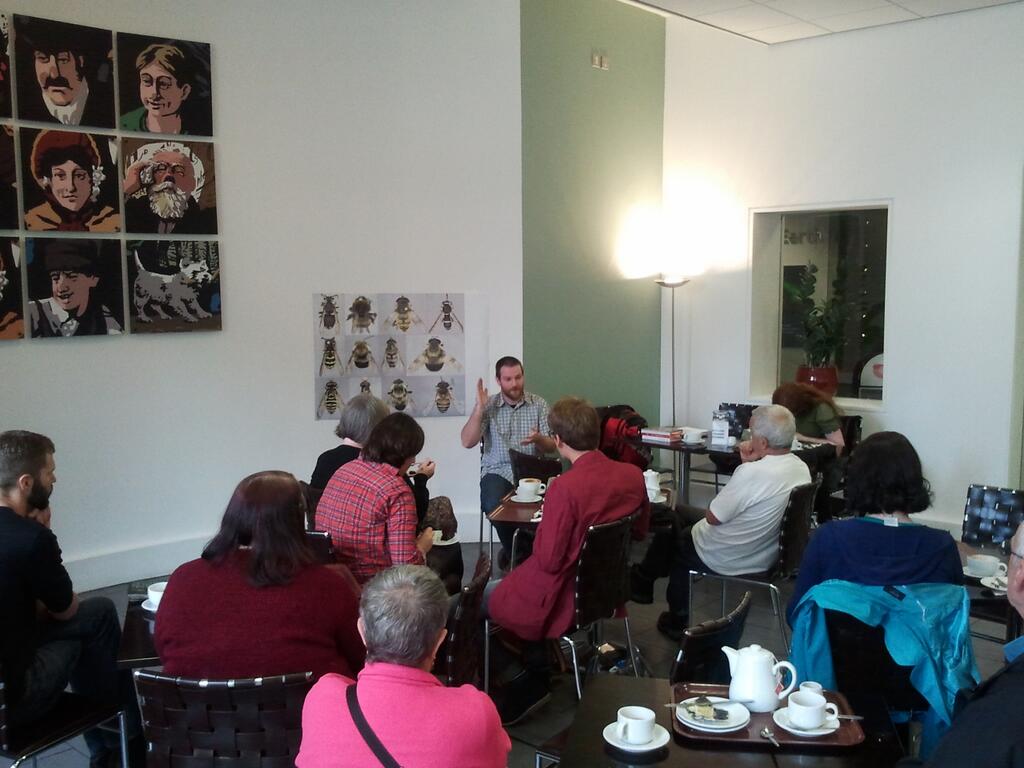


 Last week, I had an interesting conversation over coffee with some colleagues who don’t use Twitter. There were a lot of concerns over whether


 Katatrepsis