
At a time when student : staff ratios are relatively high, it can be difficult to provide the one-to-one attention that students might need in order to get the most out of their time at university, school or college. Office hours are one way in which we as teachers can set aside some of our time to deal with pressing issues. However, the regular format of these office hours tends to be a long queue of students in the hall outside a teacher’s office, and limited contact with individual students who might all have the same question. There are a number of ways in which this process can be improved, and I’ll discuss two of those here.
Blended Learning Techniques: Blogs
Scientists have always been very good at jargon-filled articles, to the point that the academic literature itself can be almost completely inaccessible to non-specialists. In more recent times, there has been a big push for scientists to complement those articles with simpler pieces that communicate that research to the general public. In a similar way, we make a point of encouraging science students to adopt the more formal, technical aspect of science writing, but we tend not to focus on providing the skills that the students need to communicate science outside of academia. Web logs (better known as “blogs”) can be a useful medium through which to develop these skills.
A nice review of the demands of open science
The journal Psychological Inquiry has just made an issue on open access science open access. I’ve flicked through a couple of articles and they look like a thoroughly interesting combination of pros, cons, and speculations. In particular, the opening article states the needs of an open science movement very clearly in its abstract:
We call for six changes:
- full embrace of digital communication;
- open access to all published research;
- disentangling publication from evaluation;
- breaking the “one article, one journal” model with a grading system for evaluation and diversified dissemination outlets;
- publishing peer review; and
- allowing open, continuous peer review.
I think these six principles sum-up the needs of the research community quite well. We are working in an out-of-date and horribly expensive system that is not benefitting scientists or those who use the science. There has always been pushback against these kinds of measures (see the response in the same issue of Psychological Inquiry by the editor of a different journal), mostly along the lines of “it’s too hard” or “that won’t work”. However, those sorts of arguments are undermined by a number of journals which are doing precisely these things extremely well. I’ll mention Cryosphere as an example that I have had experience with. A few small changes could go a very long way towards improving the system, and we cannot let the editors and publishers try to convince us that it cannot be done!
Our Skeptical Inquirer article has been published!
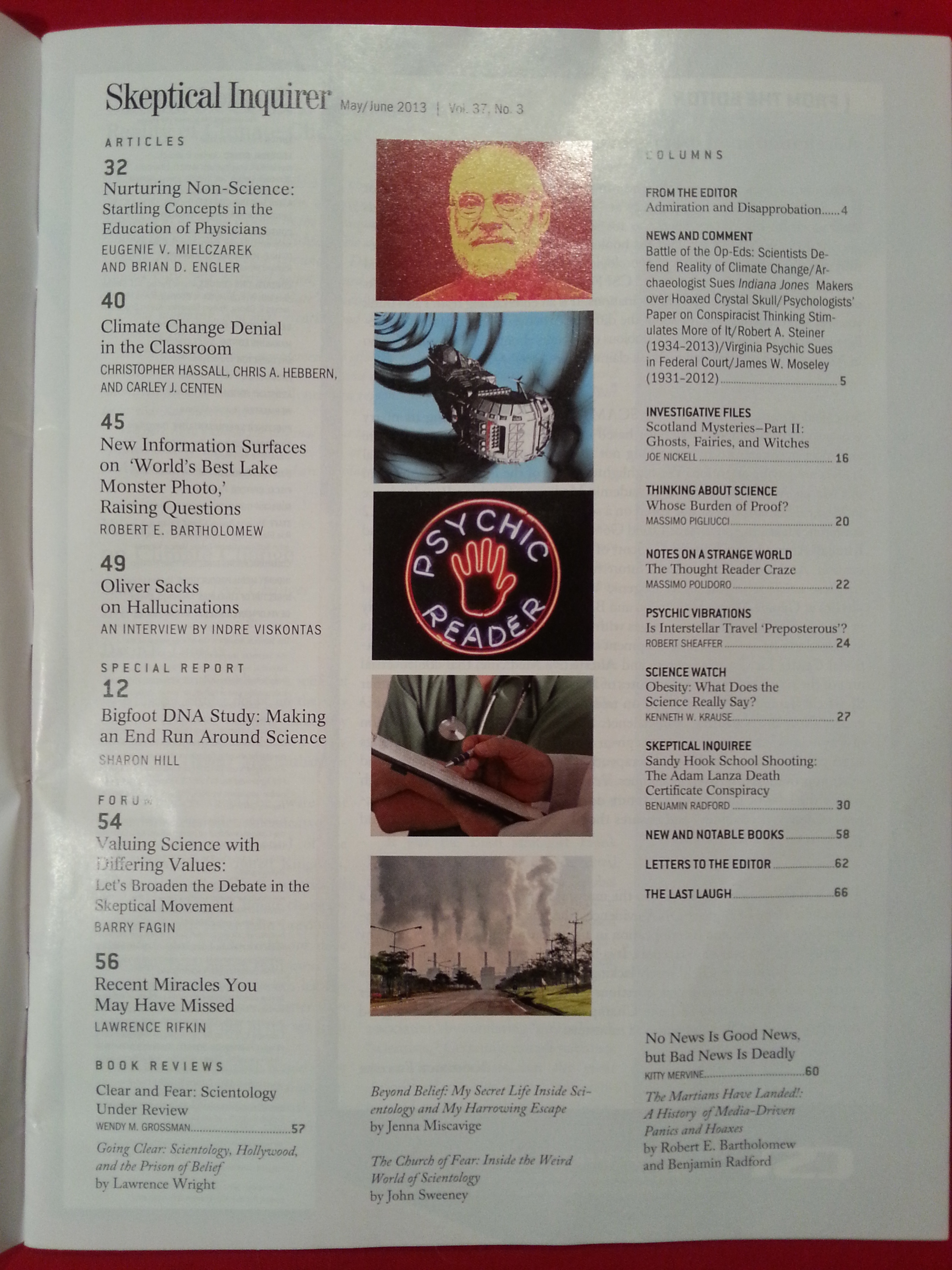
The Skeptical Inquirer piece on climate change denial in universities that I wrote (along with my co-conspirators) has just been published in the May/June 2013 print edition! It’s a bit strange to be listed alongside people like Ben Radford, Sharon Hill, Joe Nickell, Massimo Pigliucci and Massimo Polidoro, but we’re all delighted that Ken Frazier and the rest of the SI team saw enough value to accept our little piece. Many thanks to them all for a smooth and efficient editorial process. I’m afraid that there’s no online version yet (they don’t publish all the print articles online, and those that they do publish online come along a month or two after the print edition) but I’ll post a link if/when it does appear. All the more reason to go and subscribe to the print version!
Blended Learning Techniques: Using Google Forms for in-class quizzes
 I was looking around for an alternative to “clickers” (Who-Wants-to-be-a-Millionaire-style audience response technology) for use in a classroom. These tools really do help with classroom engagement, and the students seem to appreciate the opportunity to interact with the material while the teacher is present (rather than having to wait until the exam!). This also allows anonymous recording of results, banishing the fear that many students have of putting their hand up in the middle of a crowded lecture theatre. There are a few options, such as www.polleverywhere.com, www.qidiq.com, and www.soapbox.com. All of these sites use a web-based approach through an app or website to feed student responses back into a webpage or Powerpoint slide. They work reasonably well, but are limited by either (i) not being free (a problem in this time of university cost-cutting), or (ii) being a tiny bit complicated to use at first (a major issue that reduces the adoption of new technology in teaching). I went looking for an alternative and found Google Forms to be quite a useful little tool.Read More »
Three simple reasons why MOOCs are a good thing
 A group of UK universities (mine included) have embarked upon a new initiative called “FutureLearn” which seeks to take the raw success of MOOC providers like Udacity, EdX and Coursera (almost exclusively North American) and build them into a diverse and viable teaching framework. This is a really exciting opportunity for the UK universities involved, and I am looking forward to seeing how it turns out. I also have a vested interest, as I am (as of a couple of weeks ago) chairing a Faculty committee on the integration of technology into student learning. However, I have been reading a lot of material about MOOCs that has been less than positive and so I think it is probably worth pointing out some important benefits of MOOCs to help balance the debate:Read More »
Green space is good for your health (also, Pope is Catholic)
 This may not come as a surprise to many, but living in an urban environment may not be great for your mental health… Being constantly surrounded by hustle and bustle, and constantly plugged in to technologies that keep you connected to work and current events, can be a drain. Now a new study, published in the journal Psychological Science in April 2013 (although I can’t find the actual paper online, yet), has provided yet more evidence for an important role of green space in urban areas for the purposes of enhancing “life satisfaction” and general health. The study used over 10,000 participants, with data recorded over an 18 year period.
It’s worth noting the limitations of this study – it was epidemiological, which means that a lot of variables were recorded and the authors attempted to tease apart correlations between those variables. The result is that we cannot infer causation. For example, a clearer result would have been generated by an empirical approach involving a trial with randomly selected people being placed in either high green space or low green space areas, with their mental health measured before and after. However, it is worth noting that the authors took huge numbers of variables into account when analysing these data, and the datasets are very large. All of this suggests that the results are reliable. They also produced a nice, simple video to explain the results in more detail (a great example of outreach by the researchers involved!):
Photo of Roundhay Park, Leeds, by Green Lane (via Wikimedia Commons)
If you ever wondered why New Zealand has such strict immigration laws…
…it’s to maintain the awesome:
Leeds Big Data Week (big data for conservation biology)
 I’m excited to be a part of Big Data Week this year. For those of you who aren’t familiar with the phenomenon of big data, IBM has a pretty good definition. In essence, we are collecting huge amounts of data by virtue of living in a technologically advanced world, and those data are collected rapidly in a diverse range of formats. The challenge now is what to do with all of it! Big Data Week, which is running from 22-28 April 2013, is an international movement that was established in 2011 to connect businesses, data scientists, and technology groups to explore novel social, political, technological and commercial applications of big data. Leeds Data Thing is my local big data group, formed in 2013 to provide a venue for the discussion of local big data applications. They are putting on a range of events for BDW 2013, and I have volunteered to give a short presentation at one of those events.
Beetles on flowers

I took this photo while I was teaching on a field course in Spain earlier this month (harder work than it sounds). It was a nice opportunity to try out my camera (which I have been trying and failing to do on this blog) as spring is in full swing over there. I was amazed by the diversity of animals that I only found on flowers (although part of that might have been that the flower-dwellers were more noticeable…), but I was surprised to see what look like two different life history stages of potentially the same species on a single flower. Does anybody know what this beetle is…?
UPDATE 21/7/13: My friend Patrick suggests that it could be Cryptocephalus rugicollis. Looks like a good call to me!
 Katatrepsis