Launch of a new project: the West Yorkshire Ponds Project (WYPP)

I feel that I should demote myself from “blogger” to “occasional blogger”…  But I have an excuse!  Exciting things are happening, and I have been involved in some new projects which have taken up a considerable amount of time.  Aside from a massive EU grant application (which has taken an inordinate amount of time to produce 25,000 words), I have also been finalising the launch of the West Yorkshire Ponds Project (WYPP, click the image to go to the page):

WYPP is the beginning of a new research project that I have had in the pipeline for some time.  The aim is to spread knowledge about the value of urban wetlands (focusing on the West Yorkshire region for now) while seeking collaborations with which to advance that knowledge.  Feel free to browse around the www.wypp.org site to find out more about the value of ponds (flood prevention, pollution reduction, biodiversity enhancement), and how school ponds can bring nature within reach of the most inner-city of schools.

I’d appreciate feedback or comments on the site, and I’d love to hear from anyone in the West Yorkshire area who might be interested in working with me on this project.  It is going to be very community-oriented so the more the merrier!

While we wait for the open access revolution, self-archive!

I’ve just had a paper published on open access in ecology and evolution, so I thought I would let you know what it’s all about.  I wrote a few weeks ago about how you can often post more of a scientific paper online without violating copyright than you might think.  I went through a couple of journals in which I had published articles, and tried to work out what I could self-archive.  The answer was usually “quite a lot”!  Then someone in the comments popped up and mentioned the SHERPA-ROMEO website, which allows you to search for the name of the journal in which your paper has been published and then shows you the policy on self-archiving.  Well, being the data-lover that I am I decided to check out the rest of the journals in ecology and evolutionary biology (all 165 that were listed on Thomson Reuters Journal Citation Reports).  The results were pretty interesting…

Read More »

My PhD thesis in the ten hundred most used words

Calopteryx splendens femaleInspired by this xkcd comic, and facilitated by this online tool, people have been summarising all kinds of ideas using the 1,000 most common words.  Naturally PhD students have latched onto this as a source of procrastination and, in a show of solidarity, I decided to join them (this was during my lunch break – honest!).  Here’s my PhD thesis:

My work looks at how animals change as the world gets warmer.  My animal is like a fly but it has four flying bits, eats other animals, and has big eyes.  By looking at where people saw these animals in the past, I figured out how the place and time at which they appear changes with how hot it is.   I found that they appear earlier when it is hot, which is interesting because these animals spend most of their lives in water.  Animals in water had not been shown to change when they appear in this way before.   I also looked at the ways in which we look at changes in where animals appear and showed the best way to look at this problem.  Last, I looked at how the form of these animals changes as they move when it gets hotter.  I found that the animals that had moved a long way had a form that made it easy for them to move (like big flying bits).  In short, the changes shown by the animals that I looked at can be used to build a case for a warming world.

How much of an academic paper can you post online? Most of it!!

Edit: As was pointed out in the comments, you can find self-archiving info for most journals at http://www.sherpa.ac.uk/romeo/ [h/t Laurent]

I have been a bit frustrated about scientific publishing, as you might have been able to tell if you read some of my earlier posts on open access in academia.  I posted earlier this week about Aaron Swartz and the legal predicament in which he found himself when he downloaded huge numbers of scientific papers.  I was frustrated at the lack of access that most people experience to academic publishing, but didn’t want to resort to breaking the law to remedy the situation.  However, a certain amount of that frustration could have been relieved had I just taken the time to figure out where the boundaries lie in the copyright documents that I sign when I publish papers.  I decided to have a look to see how many of my rights remain, and I was quite interested to find out that I can post a reasonable amount of information on the web without breaking any laws.  As ever, this isn’t legal advice.  However, there do seem to be a few generalities that others can use to guide the release of their publications depending upon the publisher that owns the journals within which their papers are published:Read More »

The (current) limits of open access and #PDFtribute

EDIT [18/1/13]: At almost exactly the same time as I was posting about how the revolution was coming, the revolution started.  Mathematicians are setting up community-run, open access journals independent of larger publishers.

I had never heard of Aaron Swartz before he died.  Swartz was 2 1/2 years younger than me and spent his life working on, with, and around the internet and its various limitations.  I have a lot of respect for what he accomplished, not only in terms of the technical progress that he was a part of, but also because of his philosophy about open access to information.  In the wake of his death, supporters took to Twitter to post free copies of their publications, whether or not the material was in the public domain.  This reflects Swartz’s actions in downloading millions of academic papers from the MIT network which precipitated the court case that he was fighting when he chose to end his life.Read More »

Sexism is a (horrible and depressing) fact

When I posted the proposed method to look at diversity in skeptical/atheist conferences, one comment was particularly illuminating.  I stated that part of the motivation for the exercise was that:

“…there is clear and unequivocal discrimination against women in a wide array of situations and so we should be conscious of that bias when we choose speakers for conferences.”

A commenter responded that:

“Ok, I’m not sure as to what you are referring, it appears you are just performing some vague political posturing. If there were clear, and unequivocal discrimination against women at these conferences, you wouldn’t need a study to demonstrate it. It would be clear and unequivocal, such as a sexist, limiting clause in an organization’s charter. No such thing exists, so your point seems moot.”

Unfortunately, the commenter is taking a very simplistic view of sexism.  Systemic sexism of the kind to which I was referring is an insidious and far-reaching problem.  This post is a quick review of some empirical demonstrations of the subtle and systemic bias that women face, because it is clear than some people need to be made aware of the extent of the problem.  This is not a post of vague anecdotes, though – these are scientific studies.Read More »

Open Education III: How to post lectures/talks online

Next post, I will deal with one of the main barriers to the implementation of blended learning: the fear that providing online content will lead to a drop in student lecture attendance or performance.  However, the other side of the coin is that the academics who populate our universities simply do not want to have to learn new technologies to use in their teaching.  In a bizarre state of affairs, those researchers who are at the forefront of the most technological fields consider themselves incapable of learning a basic piece of software.  I’m going to try to make it clear how easy these tools can be to use, so that there are no such excuses!  All of these examples will be based around the provision of online lecture recordings.Read More »

Open Education I: Why is open access to education important?

Classroom
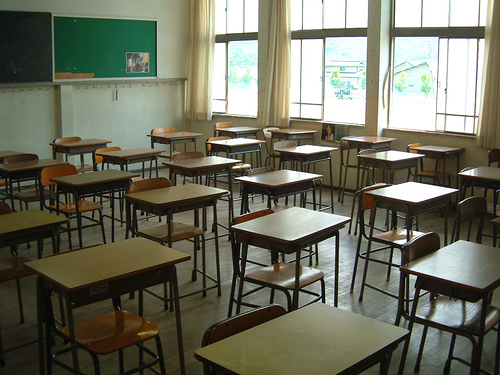
Are classrooms outdated? (image by Flickr user frwl)

I have blogged before about why I feel that open access to research and educational materials is an important step forward for society.  This promotes the learning of those who struggle to access conventional learning modalities (e.g. lower socioeconomic groups who are traditionally excluded from universities) and those who are simply casually interested in learning something new without the need to commit to long-term and expensive courses.  The release of data also helps to facilitate the verification of findings in the scientific sphere to avoid the problems associated with scientific publishing.

Read More »

Climate change denial: advice for skeptical projects

To round-out this quick series on the climate denial project, I thought I would reflect on some of the aspects of the project in the context of skeptical activism.  There are a wide range of these kinds of projects, and it is worthwhile attempting to share best practice when we can in order to make the most of limited (often volunteer-based) resources.  I know that the Eschaton2012 conference recently had a panel on skeptical activism which probably covered the same points, so I suggest you check that out as well.  Jeff Shallit has some interesting points for individuals, but this will consider what groups can accomplish.  Which leads me nicely into…Read More »

Climate change denial: my experience with the media

This is my third post relating to a project that looked at climate change denial as it was being taught in a Canadian university (see here for background, and here for response to some criticism).  We were expecting the skeptical community to pick it up, and the report was written mostly for that audience.  What we were not expecting was international media coverage and a few dozen blog posts.  Here, I will briefly reflect on what the media contact was like.

Read More »