
At a time when student : staff ratios are relatively high, it can be difficult to provide the one-to-one attention that students might need in order to get the most out of their time at university, school or college. Office hours are one way in which we as teachers can set aside some of our time to deal with pressing issues. However, the regular format of these office hours tends to be a long queue of students in the hall outside a teacher’s office, and limited contact with individual students who might all have the same question. There are a number of ways in which this process can be improved, and I’ll discuss two of those here.
Category: Education
Blended Learning Techniques: Blogs
Scientists have always been very good at jargon-filled articles, to the point that the academic literature itself can be almost completely inaccessible to non-specialists. In more recent times, there has been a big push for scientists to complement those articles with simpler pieces that communicate that research to the general public. In a similar way, we make a point of encouraging science students to adopt the more formal, technical aspect of science writing, but we tend not to focus on providing the skills that the students need to communicate science outside of academia. Web logs (better known as “blogs”) can be a useful medium through which to develop these skills.
Our Skeptical Inquirer article has been published!
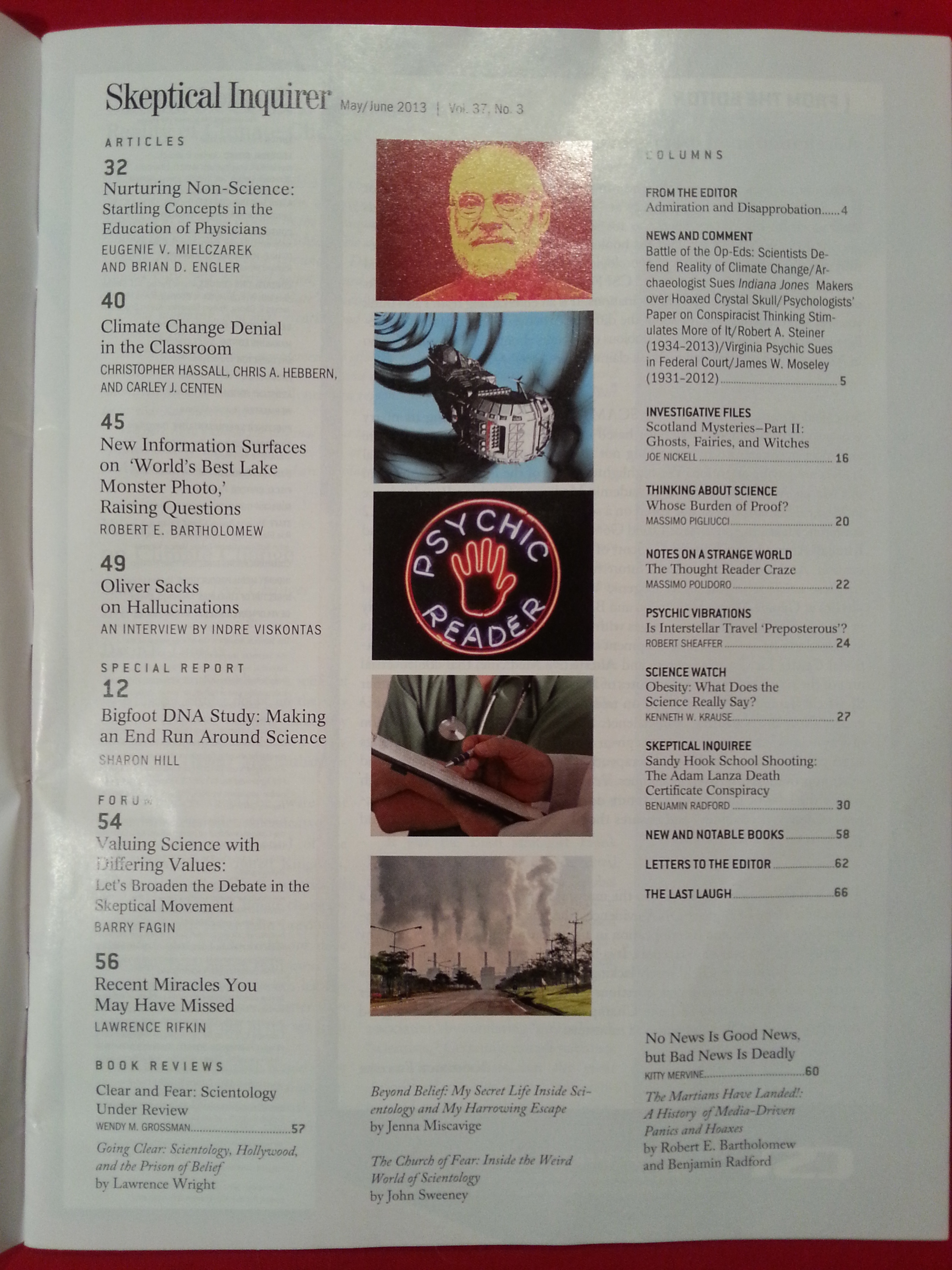
The Skeptical Inquirer piece on climate change denial in universities that I wrote (along with my co-conspirators) has just been published in the May/June 2013 print edition! It’s a bit strange to be listed alongside people like Ben Radford, Sharon Hill, Joe Nickell, Massimo Pigliucci and Massimo Polidoro, but we’re all delighted that Ken Frazier and the rest of the SI team saw enough value to accept our little piece. Many thanks to them all for a smooth and efficient editorial process. I’m afraid that there’s no online version yet (they don’t publish all the print articles online, and those that they do publish online come along a month or two after the print edition) but I’ll post a link if/when it does appear. All the more reason to go and subscribe to the print version!
Blended Learning Techniques: Using Google Forms for in-class quizzes
 I was looking around for an alternative to “clickers” (Who-Wants-to-be-a-Millionaire-style audience response technology) for use in a classroom. These tools really do help with classroom engagement, and the students seem to appreciate the opportunity to interact with the material while the teacher is present (rather than having to wait until the exam!). This also allows anonymous recording of results, banishing the fear that many students have of putting their hand up in the middle of a crowded lecture theatre. There are a few options, such as www.polleverywhere.com, www.qidiq.com, and www.soapbox.com. All of these sites use a web-based approach through an app or website to feed student responses back into a webpage or Powerpoint slide. They work reasonably well, but are limited by either (i) not being free (a problem in this time of university cost-cutting), or (ii) being a tiny bit complicated to use at first (a major issue that reduces the adoption of new technology in teaching). I went looking for an alternative and found Google Forms to be quite a useful little tool.Read More »
Three simple reasons why MOOCs are a good thing
 A group of UK universities (mine included) have embarked upon a new initiative called “FutureLearn” which seeks to take the raw success of MOOC providers like Udacity, EdX and Coursera (almost exclusively North American) and build them into a diverse and viable teaching framework. This is a really exciting opportunity for the UK universities involved, and I am looking forward to seeing how it turns out. I also have a vested interest, as I am (as of a couple of weeks ago) chairing a Faculty committee on the integration of technology into student learning. However, I have been reading a lot of material about MOOCs that has been less than positive and so I think it is probably worth pointing out some important benefits of MOOCs to help balance the debate:Read More »
Launch of a new project: the West Yorkshire Ponds Project (WYPP)
I feel that I should demote myself from “blogger” to “occasional blogger”… But I have an excuse! Exciting things are happening, and I have been involved in some new projects which have taken up a considerable amount of time. Aside from a massive EU grant application (which has taken an inordinate amount of time to produce 25,000 words), I have also been finalising the launch of the West Yorkshire Ponds Project (WYPP, click the image to go to the page):

WYPP is the beginning of a new research project that I have had in the pipeline for some time. The aim is to spread knowledge about the value of urban wetlands (focusing on the West Yorkshire region for now) while seeking collaborations with which to advance that knowledge. Feel free to browse around the www.wypp.org site to find out more about the value of ponds (flood prevention, pollution reduction, biodiversity enhancement), and how school ponds can bring nature within reach of the most inner-city of schools.
I’d appreciate feedback or comments on the site, and I’d love to hear from anyone in the West Yorkshire area who might be interested in working with me on this project. It is going to be very community-oriented so the more the merrier!
How much of an academic paper can you post online? Most of it!!
Edit: As was pointed out in the comments, you can find self-archiving info for most journals at http://www.sherpa.ac.uk/romeo/ [h/t Laurent]
I have been a bit frustrated about scientific publishing, as you might have been able to tell if you read some of my earlier posts on open access in academia. I posted earlier this week about Aaron Swartz and the legal predicament in which he found himself when he downloaded huge numbers of scientific papers. I was frustrated at the lack of access that most people experience to academic publishing, but didn’t want to resort to breaking the law to remedy the situation. However, a certain amount of that frustration could have been relieved had I just taken the time to figure out where the boundaries lie in the copyright documents that I sign when I publish papers. I decided to have a look to see how many of my rights remain, and I was quite interested to find out that I can post a reasonable amount of information on the web without breaking any laws. As ever, this isn’t legal advice. However, there do seem to be a few generalities that others can use to guide the release of their publications depending upon the publisher that owns the journals within which their papers are published:Read More »
Open Education III: How to post lectures/talks online
Next post, I will deal with one of the main barriers to the implementation of blended learning: the fear that providing online content will lead to a drop in student lecture attendance or performance. However, the other side of the coin is that the academics who populate our universities simply do not want to have to learn new technologies to use in their teaching. In a bizarre state of affairs, those researchers who are at the forefront of the most technological fields consider themselves incapable of learning a basic piece of software. I’m going to try to make it clear how easy these tools can be to use, so that there are no such excuses! All of these examples will be based around the provision of online lecture recordings.Read More »
Open Education I: Why is open access to education important?

I have blogged before about why I feel that open access to research and educational materials is an important step forward for society. This promotes the learning of those who struggle to access conventional learning modalities (e.g. lower socioeconomic groups who are traditionally excluded from universities) and those who are simply casually interested in learning something new without the need to commit to long-term and expensive courses. The release of data also helps to facilitate the verification of findings in the scientific sphere to avoid the problems associated with scientific publishing.
Climate change denial: advice for skeptical projects

To round-out this quick series on the climate denial project, I thought I would reflect on some of the aspects of the project in the context of skeptical activism. There are a wide range of these kinds of projects, and it is worthwhile attempting to share best practice when we can in order to make the most of limited (often volunteer-based) resources. I know that the Eschaton2012 conference recently had a panel on skeptical activism which probably covered the same points, so I suggest you check that out as well. Jeff Shallit has some interesting points for individuals, but this will consider what groups can accomplish. Which leads me nicely into…Read More »
 Katatrepsis